Introduction
Modern dental offices rely on digital imaging to deliver fast, accurate diagnoses while keeping patients safe. Digital X‑rays replace film with electronic sensors, giving instant, high‑resolution pictures and cutting radiation exposure by up to 90% compared with traditional radiographs. Cone‑beam computed tomography (CBCT) takes imaging a step further, creating true three‑dimensional images of teeth, bone, nerves and sinuses in a single quick scan. Although CBCT uses more radiation than a standard 2‑D X‑ray, its dose is far lower than that of a medical CT scan and often comparable to a full‑mouth series of conventional films. The detailed 3‑D view is essential for implant planning, orthodontic assessment, TMJ evaluation, and detecting hidden pathology, making CBCT a cornerstone of precise, patient‑centered dental care.
CBCT Technology, Radiation, and Cost Considerations
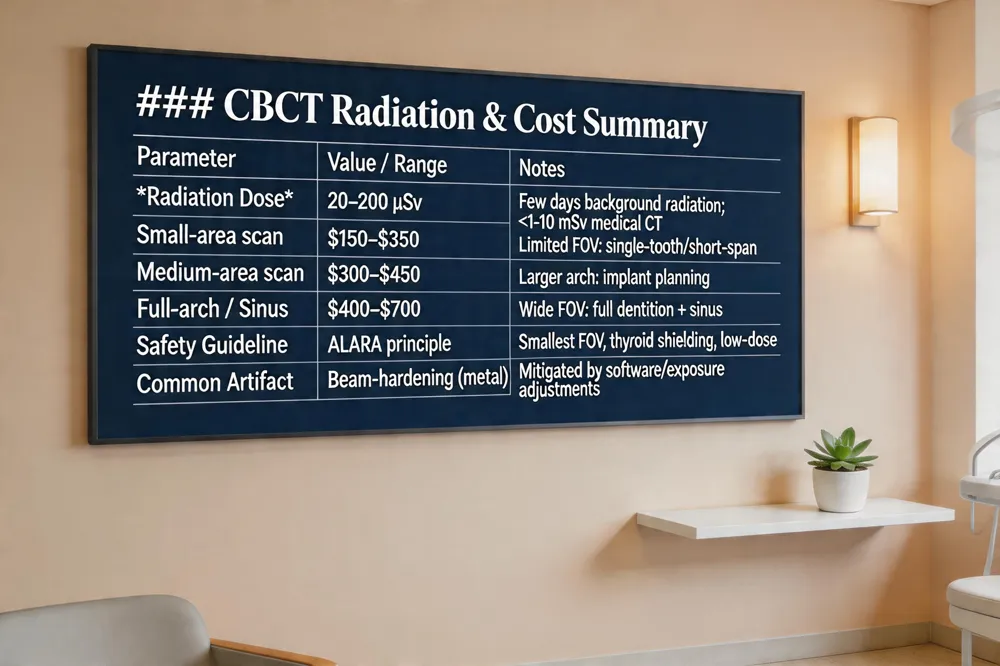
CBCT Radiation & Cost Summary
| Parameter | Value / Range | Notes |
|---|---|---|
| Radiation Dose | 20 – 200 µSv | Roughly a few days of background radiation; far lower than 1–10 mSv of conventional medical CT. |
| Small‑area scan | $150 – $350 | Limited FOV, suitable for single‑tooth or short‑span imaging. |
| Medium‑area scan | $300 – $450 | Covers larger arch segments; common for implant planning. |
| Full‑arch / Sinus | $400 – $700 | Wide FOV, includes sinus anatomy and full dentition. |
| Safety Guideline | ALARA principle | Use smallest FOV, thyroid shielding, low‑dose protocols. |
| Common Artifact | Beam‑hardening (metal) | Mitigated by software correction or exposure adjustments. |
 Cone‑beam computed tomography (CBCT) captures a 3‑D volumetric image of the teeth, jawbone, nerves and surrounding soft tissues in a single, under‑minute rotation. A cone‑shaped X‑ray beam sweeps around the patient’s head, acquiring 150‑200 high‑resolution projections that are reconstructed into axial, sagittal and coronal slices.
Radiation dose from a dental CBCT ranges from 20 to 200 µSv—roughly the amount of natural background radiation a person receives over a few days and far lower than the 1–10 mSv of a conventional medical CT. Compared with a full‑mouth series of traditional X‑rays, a limited‑field CBCT can be comparable or even lower in dose, while still providing three‑dimensional detail.
Pricing varies by field‑of‑view and practice location: small‑area scans typically cost $150‑$350, medium scans $300‑$450, and full‑arch or sinus scans $400‑$700. Many dental insurance plans cover medically necessary CBCTs, often leaving only a co‑pay; in‑office imaging is usually more affordable than referring to an external center.
Safety guidelines follow the ALARA principle—using the smallest FOV needed, shielding the thyroid, and employing low‑dose protocols. The most common artifact is beam‑hardening caused by metal restorations, which can be mitigated with software correction or adjusted exposure settings.
Overall, when a CBCT is clinically indicated, its diagnostic benefits outweigh the minimal radiation risk, making it a safe and valuable tool in modern dental care.
Clinical Uses and Incidental Findings of CBCT
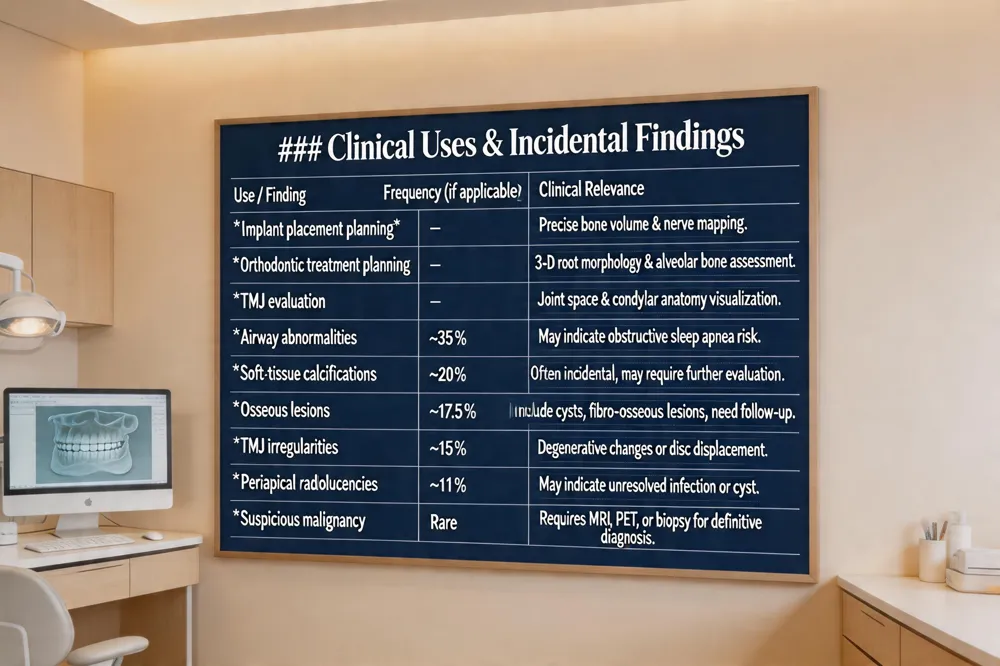
Clinical Uses & Incidental Findings
| Use / Finding | Frequency (if applicable) | Clinical Relevance |
|---|---|---|
| Implant placement planning | – | Precise bone volume & nerve mapping. |
| Orthodontic treatment planning | – | 3‑D root morphology & alveolar bone assessment. |
| TMJ evaluation | – | Joint space & condylar anatomy visualization. |
| Airway abnormalities | ~35 % | May indicate obstructive sleep apnea risk. |
| Soft‑tissue calcifications | ~20 % | Often incidental; may require further evaluation. |
| Osseous lesions | ~17.5 % | Include cysts, fibro-osseous lesions; need follow‑up. |
| TMJ irregularities | ~15 % | Degenerative changes or disc displacement. |
| Periapical radiolucencies | ~11 % | May indicate unresolved infection or cyst. |
| Suspicious malignancy | Rare | Requires MRI, PET, or biopsy for definitive diagnosis. |
 CBCT imaging is ordered when traditional 2‑D X‑rays cannot supply enough detail for accurate diagnosis or treatment planning. The 3‑D images reveal jawbone shape, bone density, nerve pathways, sinus anatomy, and hidden pathologies such as root fractures, cysts, or impacted teeth, making the scan essential for implant placement, orthodontic planning, TMJ evaluation, and surgical guide design.
3‑D CBCT (Cone Beam Computed Tomography (CBCT)) uses a cone‑shaped X‑ray beam that rotates around the patient’s head, capturing hundreds of views that are reconstructed into a volumetric model. This true three‑dimensional view allows clinicians to assess roots, nerves, and sinuses with far greater accuracy than flat 2‑D radiographs.
Common incidental findings on CBCT include airway abnormalities (≈35% of scans), soft‑tissue calcifications (≈20%), osseous lesions (≈17.5%), TMJ irregularities (≈15%), and periapical radiolucencies (≈11%). Developmental anomalies and true pathological lesions are less frequent but still clinically relevant.
While CBCT can flag abnormal bone or tissue densities that may suggest cancer, it is not a definitive diagnostic tool for malignancy. Suspicious areas are typically followed up with MRI, PET, or biopsy to confirm a diagnosis.
Overall, CBCT provides a comprehensive, low‑radiation view that improves diagnostic confidence, streamlines treatment planning, and enhances patient safety.
Digital Dentistry: Scanners, Impressions, and Dentures
Digital Dentistry Technologies
| Technology | Accuracy / Resolution | Key Advantages |
|---|---|---|
| Intra‑oral scanner | 20‑30 µm (micron‑level) | Non‑invasive, eliminates trays, instant visual feedback. |
| CAD/CAM software | – | Designs crowns, bridges, orthodontic appliances, surgical guides. |
| 3‑D printers / milling | – | On‑site restoration fabrication, reduced turnaround time. |
| Digital dentures | – | Precise fit, durable, hygienic, reproducible from permanent digital file. |
| CBCT integration | – | Provides bone, nerve, sinus anatomy for comprehensive planning. |
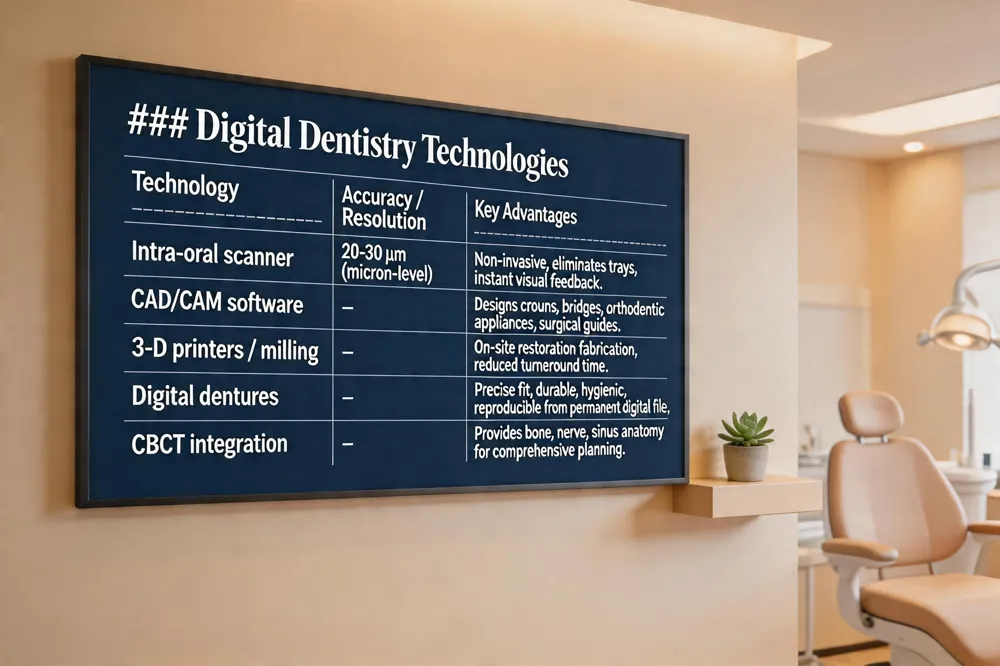 Digital dentistry is a suite of computer‑driven tools that streamline every step of care. Intra‑oral scanners capture high‑resolution images and 3‑D digital impressions, eliminating messy trays and gag‑reflex triggers. These scans feed CAD/CAM software that designs crowns, bridges, orthodontic appliances, and surgical guides, while 3‑D printers and milling units produce the restorations on‑site. Cone‑beam computed tomography (CBCT) adds detailed 2‑D and 3‑D imaging of bone, nerves, and sinuses, supporting implant planning and TMJ assessment.
Advantages of digital impressions include micron‑level accuracy (20‑30 µm), instant visual feedback, reduced chair‑time, and a completely non‑invasive patient experience. Digital files are stored electronically, allowing rapid sharing with labs and specialists, and they eliminate the distortion risk of traditional materials.
Digital dentures are created from precise intra‑oral scans and CAD/CAM design, delivering a more accurate, comfortable fit that often requires fewer adjustment visits. The solid, non‑porous material is durable, hygienic, and resistant to bacterial buildup. Because the digital file is permanent, a lost or damaged denture can be reproduced quickly without a new impression.
Patients can eat with digital dentures, beginning with soft foods and gradually progressing to a normal diet as confidence builds. The robust 3‑D‑printed material handles a wider range of foods than traditional acrylic, and a thin layer of denture adhesive can provide extra stability during the adjustment period.
Patient‑Centric Benefits and Future Directions
Patient‑Centric Benefits & Future Directions
| Benefit / Future Trend | Description |
|---|---|
| Real‑time 3‑D visualization | Clinicians can show patients their anatomy instantly, enhancing education and shared decision‑making. |
| In‑office imaging (<1 min) | Shorter appointments, immediate results, on‑the‑spot treatment planning. |
| AI‑assisted analysis | Automated pathology detection, bone volume measurement, and guide generation streamline workflow. |
| 3‑3‑3 oral‑hygiene rule | Brush three times daily, three minutes each, replace brush every three months for optimal oral health. |
| Future integration | Seamless data exchange between CBCT, intra‑oral scans, and AI platforms for fully personalized care. |
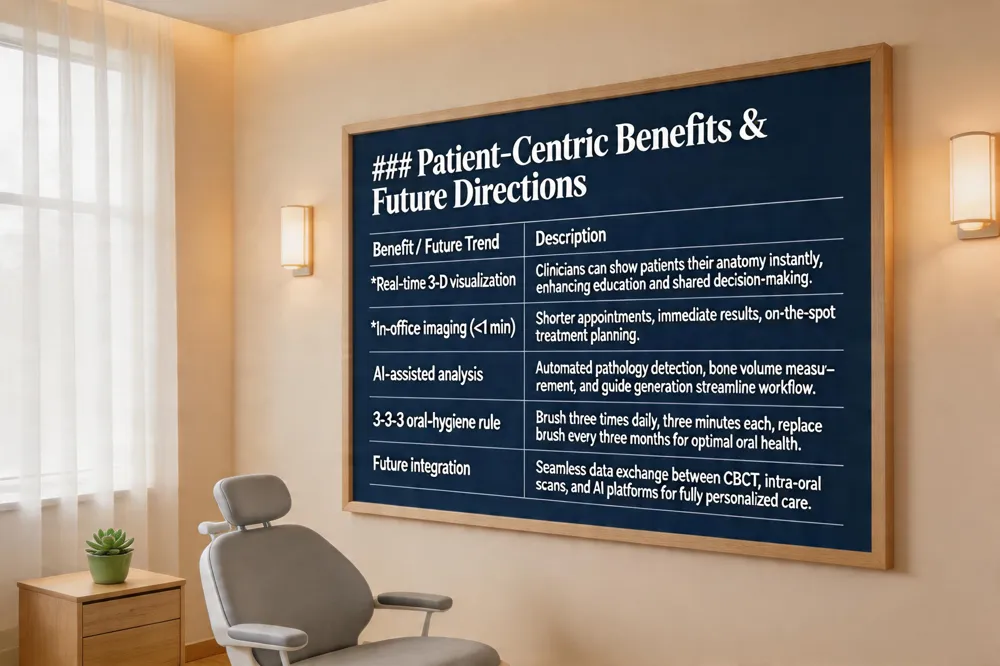 Modern dental imaging transforms how we talk with patients. High‑resolution 3‑D CBCT scans and instant digital X‑rays let clinicians show anatomy in real time, turning abstract diagnoses into clear visual stories that improve education and empower shared decision‑making. The convenience of in‑office imaging—often completed in under a minute—means appointments are shorter, results are available immediately, and treatment plans can be designed on the spot, reducing the need for multiple visits. As AI tools become integrated with CBCT and intra‑oral scans, software can automatically highlight pathology, measure bone volume, and generate patient‑specific surgical guides, streamlining workflow and further enhancing accuracy.
What is the 3‑3‑3 rule for teeth? The 3‑3‑3 rule is a simple oral‑hygiene guideline that encourages three key habits each day. First, brush your teeth three times—after waking, after lunch, and before bedtime—using a soft‑bristled brush and proper technique. Second, spend a full three minutes brushing each session, dividing the time among the four mouth quadrants for thorough coverage. Third, replace your toothbrush (or electric brush head) every three months, or sooner if the bristles become frayed. Following this routine helps control plaque, protect enamel, and reduce the risk of cavities and gum disease.
Conclusion
Key takeaways from 3D CBCT and digital scans: CBCT delivers high‑resolution, three‑dimensional images that reveal bone quality, nerve pathways, and hidden pathology while keeping radiation exposure far below conventional medical CT levels. Digital intra‑oral scanners provide accurate, instant 3‑D impressions, eliminating messy trays, reducing chair‑time, and improving the fit of crowns, bridges, and orthodontic appliances. Together they enable precise, prosthetically driven treatment plans, faster diagnoses, and clearer patient communication.
Future of technology‑driven dental care: Continued integration of AI‑enhanced imaging, cloud‑based data sharing, and chair‑side CAD/CAM milling will further streamline workflows, personalize treatment, and expand same‑day restorative options, making dental visits more comfortable, efficient, and patient‑centered.