Introducing Chairside Milling at Southern Boulevard Dental
Chairside milling is an in‑office CAD/CAM process that captures a digital impression of a prepared tooth, designs the crown on a computer, and mills the final restoration from a solid block of high‑strength ceramic or zirconia—all while the patient stays in the chair. The workflow begins with a comfortable, impression‑free intra‑oral scan, proceeds to real‑time design using Glidewell’s fastdesign.io™ software, and finishes with a fastmill.io™ mill that creates a fully sintered BruxZir® or lithium‑disilicate crown in roughly 30‑45 minutes. Because the entire sequence—scan, design, mill, and cementation—occurs in one appointment, Rio Rancho patients enjoy same‑day delivery, no temporary crown, and a precise, marginally accurate restoration that protects against microleakage. This digital, patient‑centered approach reduces chair time, eliminates lab shipping, lowers overall costs, and boosts satisfaction, making restorative care faster, more convenient, and even more trustworthy at Southern Boulevard Dental.
Speed and Efficiency of Chairside Milling
| Step | Approximate Time (minutes) | Description |
|---|---|---|
| Scan (intra‑oral) | 2‑5 | Capture high‑resolution 3‑D image of prepared tooth |
| Design (CAD) | 3‑7 | Create custom crown geometry and shade |
| Milling (fastmill.io™ / CEREC) | 15‑20 | Mill crown from solid ceramic or zirconia block |
| Polish & Fit Check | 5‑10 | Surface refinement, verify marginal fit |
| Total Chair Time (second appointment) | 30‑45 (as low as 15) | Remove temporary, place permanent crown, cementation |
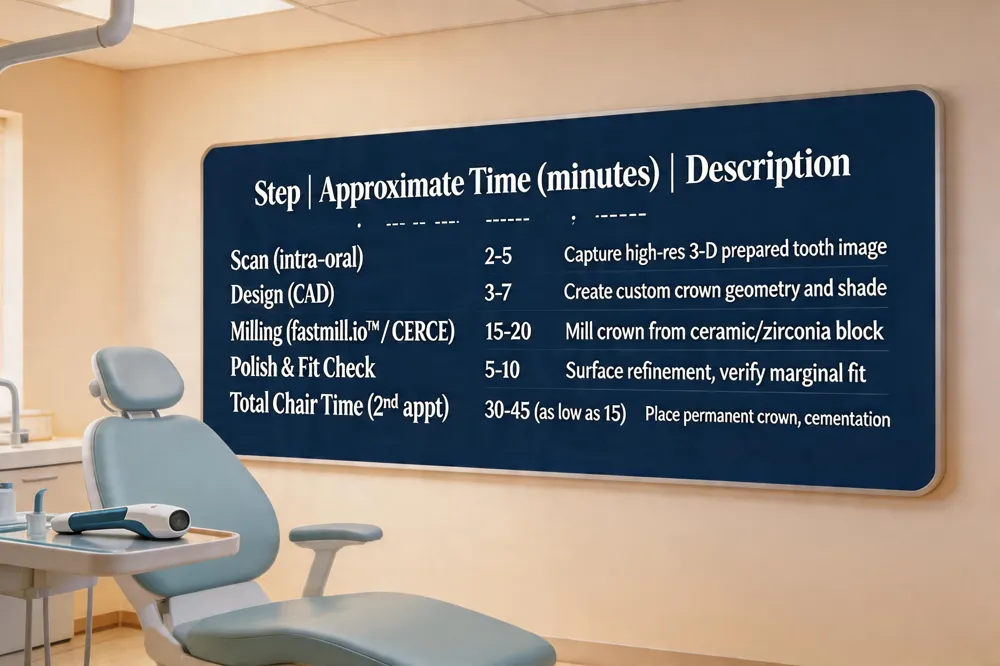 Chairside milling transforms a traditional multi‑visit crown process into a single‑appointment workflow. After the tooth is prepared, a fast intra‑oral scanner captures a high‑resolution 3‑D image that the dentist uses to design a custom crown using CAD software. The design is sent instantly to an in‑office mill, which carves the restoration from a solid ceramic or zirconia block. Modern units such as the fastmill.io™ or CEREC systems complete the milling cycle in roughly 15–20 minutes, followed by a quick polish and fit check. Because the crown is fabricated on site, the patient never needs a temporary restoration and can leave the office with a permanent, cemented crown in the same visit. The total chair time for the second appointment—removing the temporary, trying in the final crown, making any minor adjustments, and cementation—typically ranges from 30 to 45 minutes, and many cases finish in as little as 15 minutes when fit is perfect. This streamlined process not only saves patients time and reduces the inconvenience of multiple trips, it also increases practice efficiency and case acceptance, delivering durable, aesthetically pleasing crowns in under an hour from scan to placement.
Material Strength, Longevity and Technology Options
| Material | Flexural Strength (MPa) | Marginal Fit (µm) | Typical Use | Cost Range (USD) |
|---|---|---|---|---|
| Zirconia (monolithic) | 350‑900 | 20‑30 | Posterior load‑bearing teeth | $1,200‑$2,000 |
| Lithium Disilicate | 360‑460 | 20‑30 | Anterior esthetic restorations | $1,200‑$2,000 |
| Metal‑Ceramic | 400‑600 | 30‑40 | Mixed esthetics‑strength | $800‑$1,300 |
| All‑Ceramic (generic) | 300‑500 | 25‑35 | General purpose | $1,000‑$1,600 |
| 3D‑Printed Resin (temporary) | 50‑100 | 40‑60 | Provisional crowns | $50‑$150 |
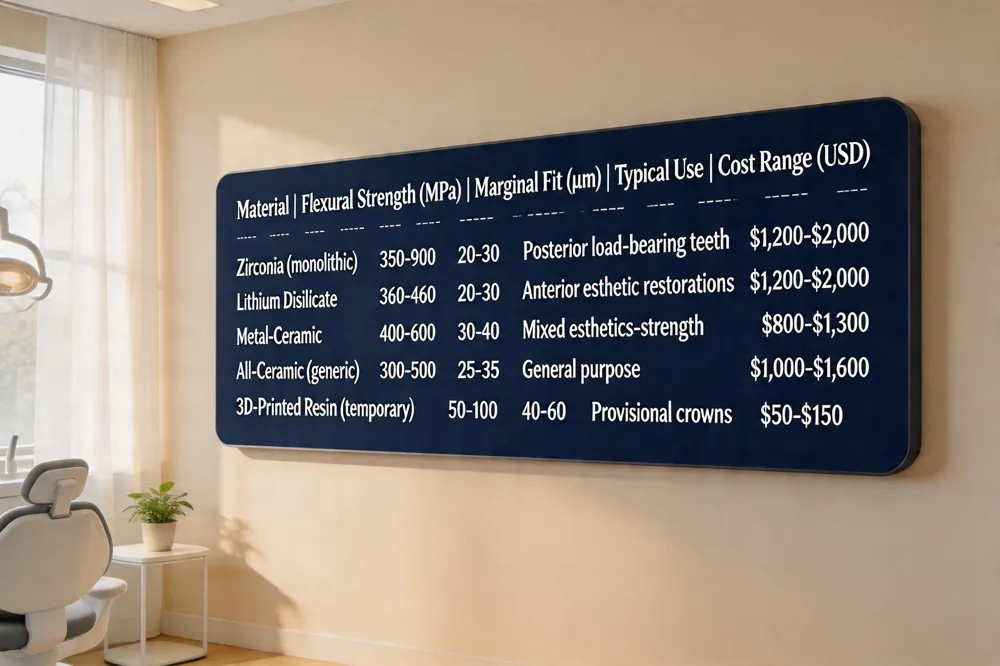 Modern dentistry offers several crown options, each with its own strength, aesthetic qualities, and cost profile. High‑strength ceramics such as zirconia and lithium disilicate dominate Chairside milling because they provide flexural strengths above 350 MPa, excellent wear resistance, and a natural translucency that mimics enamel. Zirconia is ideal for posterior load‑bearing teeth, while lithium disilicate delivers superior esthetics for anterior restorations.
3D‑printed crowns are typically used as temporary solutions. They are fabricated from resin‑based hybrid materials that set quickly but lack the long‑term durability of milled ceramics. Their main advantage is rapid production—often under 20 minutes—for provisional use, but they are not intended for permanent placement.
When comparing milling versus printing, milled crowns from zirconia or lithium disilicate achieve marginal fits within 20‑30 µm and superior strength, while 3D‑printed crowns offer lower material cost and design flexibility at the expense of reduced fracture resistance. For permanent crowns, chairside milling remains the gold standard.
Types of dental crowns and cost – Metal crowns ($900‑$1,500) are the most durable but rarely chosen for front teeth. Porcelain‑fused‑to‑metal crowns cost $800‑$1,300. All‑ceramic crowns range $1,000‑$1,600, and newer zirconia or lithium‑disilicate crowns fall between $1,200‑$2,000, depending on location and laboratory.
Dental crown printing machine – A high‑precision 3‑D printer builds full‑contour crowns from resin‑based materials in minutes, integrating intra‑oral scans, CAD design, and post‑processing. It offers lower per‑crown material cost and complex geometry but is best suited for temporary restorations.
What is chairside milling? – Chairside milling uses CAD/CAM technology to scan, design, and mill a crown from a solid ceramic or zirconia block within the office, delivering a permanent restoration in a single visit and eliminating temporary crowns and lab shipping.
Financial Benefits for Patients and Practices
| Item | Cost per Crown (USD) | Insurance / Reimbursement | Practice ROI |
|---|---|---|---|
| Single‑visit ceramic crown | $1,000‑$1,500 | Major procedure code; partial coverage possible | Higher case‑acceptance, no lab shipping |
| Temporary implant crown (acrylic/composite) | $50‑$150 | Often covered as separate benefit | Low material cost, quick turnaround |
| Monthly crown volume (10‑15) | — | — | Equipment cost recouped in <12 months |
| Monthly crown volume (20) | — | — | Additional $60,000‑$62,000 profit per year |
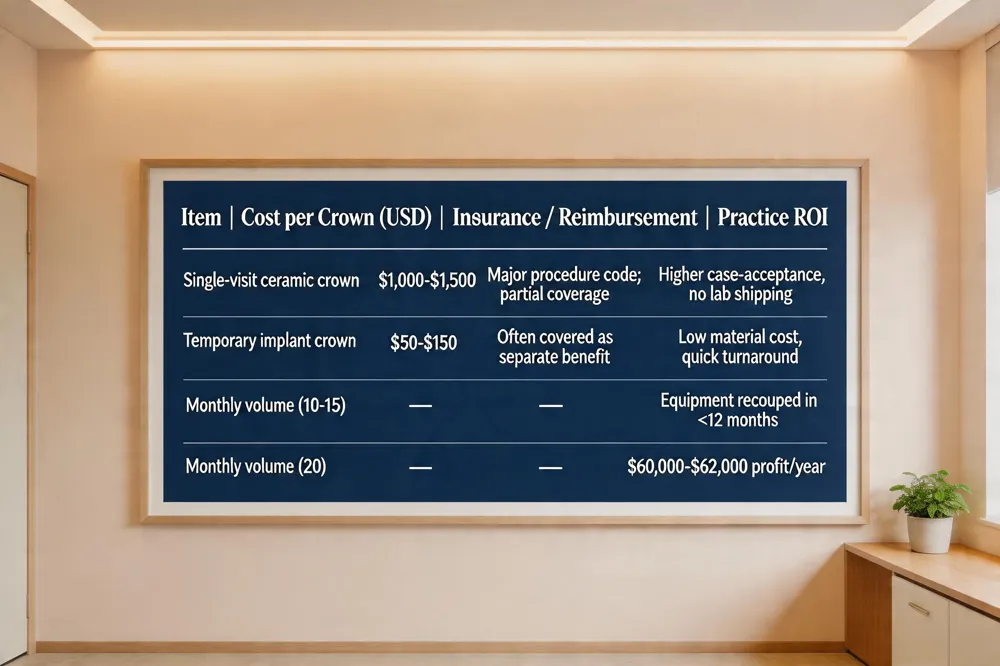 Chairside milling makes same‑day crowns affordable and convenient. In the United States a single‑visit ceramic crown typically costs $1,000–$1,500; insurance often classifies it as a major procedure and reimburses a portion, while many offices—including Southern Boulevard Dental—offer financing or in‑office payment plans. A temporary implant crown is far cheaper, ranging from $50–$150 for an acrylic or composite chairsideside, to $150–$300 for a lab‑made provisional; more complex cases may reach $200–$400. The ADA CDT code for a provisional implant crown is D6085, which should be documented with the implant site, placement date, and clinical justification. Most insurance plans treat temporary crowns as a separate benefit, and FSA/HSA funds can be applied. From the practice perspective, the ROI on an in‑office milling unit is rapid: practices that mill 10–15 crowns per month can cover equipment costs within a year, and producing 20 crowns monthly can generate an additional $60,000–$62,000 in annual profit. The elimination of lab shipping, reduced chair time, and higher case‑acceptance rates further enhance profitability while delivering patients a permanent, aesthetic restoration in a single visit.
Digital Workflow, Accuracy and Patient Comfort
| Stage | Tool/Technology | Accuracy | Typical Duration (minutes) |
|---|---|---|---|
| Intra‑oral Scan | High‑res scanner | <0.5 mm overall, 20‑30 µm marginal | 2‑5 |
| CAD Design | Proprietary software | Sub‑millimeter, 20‑30 µm marginal | 3‑7 |
| 3D‑Printed Provisional (if needed) | Hybrid‑filled resin printer | ~30‑40 µm | 5‑20 (print) + 2‑3 (post‑process) |
| Final Crown Milling | Fastmill.io™ / CEREC | 20‑30 µm | 15‑20 |
| Polish & Fit Check | Handpiece & articulator | Visual & tactile | 5‑10 |
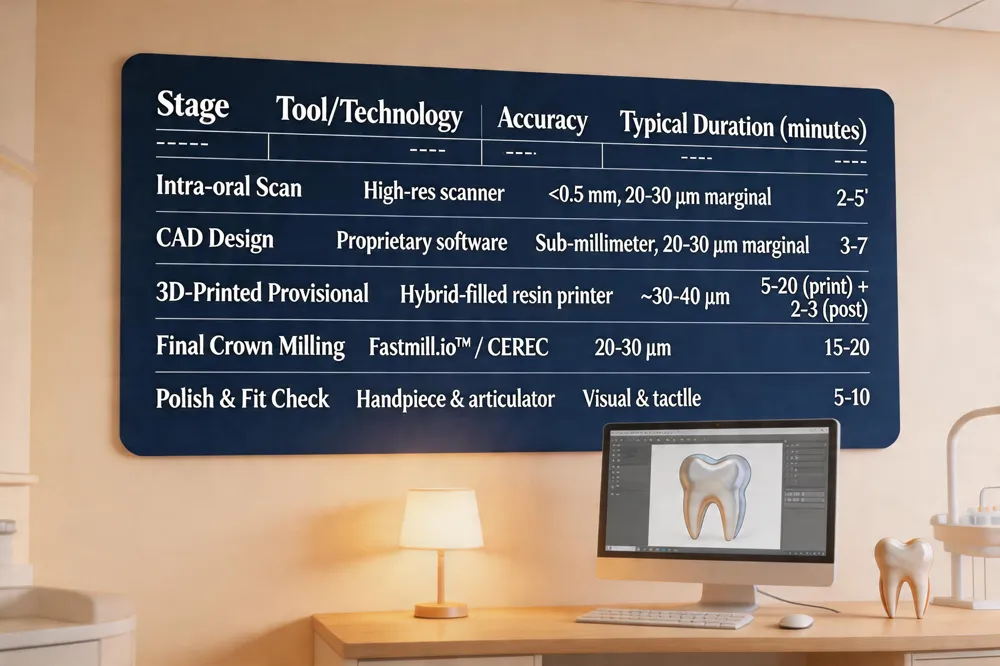 Modern chairside dentistry begins with a high‑resolution intra‑oral scan that captures the tooth preparation in seconds, replacing messy goopy impressions and delivering sub‑millimeter accuracy. The digital data flow directly into CAD software, where the dentist or trained staff can design the exact shape, margin and shade of the restoration in minutes. This precise workflow ensures a marginal fit within 20‑30 µm, minimizing micro‑leakage and protecting the tooth.
When a temporary restoration is needed, 3D‑printed provisional crowns are fabricated from the same scan. Using resin‑filled materials such as SprintRay’s hybrid‑filled or Formlabs’ Premium Teeth Resin, the crown is printed in 5‑20 minutes, cleaned, cured and cemented on the spot. The result is a strong, aesthetic provisional that matches the final crown’s color and eliminates the need for a lab‑made temporary, saving time and cost.
After crown placement, patients often experience mild soreness. A simple analgesic protocol—known as the 3‑3‑3 rule—advocates taking three 200 mg ibuprofen tablets every three hours, for up to three days, to control inflammation and discomfort. This easy regimen, combined with the same‑day delivery of a permanent restoration, greatly enhances patient satisfaction and comfort at practices like Southern Boulevard Dental.
Implant Cases and Immediate Crown Delivery
| Condition | Requirement | Crown Material | Milling Time (minutes) | Total Appointment Time (minutes) |
|---|---|---|---|---|
| Primary implant stability ≥ 30 N·cm | Immediate loading protocol | Monolithic Zirconia or Lithium Disilicate | 30‑45 | 45‑60 (including scan & placement) |
| Adequate soft‑tissue healing | Delayed loading | Same options | 30‑45 | 60‑75 (if provisional needed) |
| Use of fast™mill.io™ | Real‑time CAD/CAM integration | Zirconia | 30‑45 | 45‑60 |
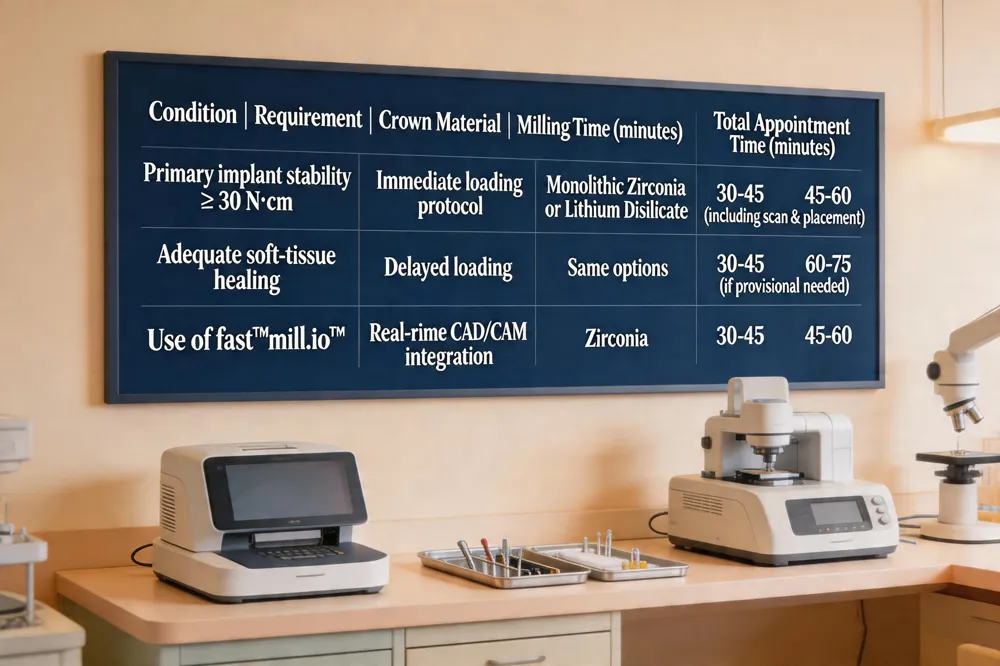 Advances in chairside CAD/CAM technology now make same‑day implant crowns possible in select cases. When the implant achieves enough primary stability at the time of placement, an intra‑oral scanner can capture the implant’s position, and a fast‑mill unit (e.g., fastmill.io™ or CEREC) can design and mill a monolithic zirconia or lithium disilicate crown in 30–45 minutes. This eliminates the need for a provisional restoration and a second appointment, providing patients with an immediate, permanent solution that matches the shade and translucency of natural teeth while reducing treatment time and improving satisfaction.
Chairside Milling—A Game Changer for Rio Rancho Dentistry
Chairside milling brings crowns to the patient in a single visit. From a digital intra‑oral scan to the final cemented restoration, the workflow takes 1.5‑2.5 hours, often under 30 minutes for simple posterior crowns. The crowns are milled from high‑strength ceramics such as zirconia or lithium disilicate, materials that exceed 350 MPa flexural strength and resist wear for years. Because the restoration is fabricated on‑site, laboratory fees, shipping costs and the need for a temporary crown disappear, lowering the overall expense for both practice and patient. Patients enjoy immediate function and aesthetics, no multiple appointments, and the comfort of a precise fit that reduces sensitivity and future adjustments. Southern Boulevard Dental in Rio Rancho offers this same‑day crown service, combining cutting‑edge CAD/CAM technology with experienced clinicians. Call today to schedule a consultation and experience the convenience of a permanent crown placed in one visit for your smile and long‑term oral health today! now.