Setting the Stage for a Digital Dental Experience
Intra‑oral scanning technology is the foundation of a modern, patient‑centric workflow. A high‑resolution scanner captures the entire arch in seconds, eliminating messy impression trays and the gag reflex while providing a precise 3‑D model that is instantly uploaded to a secure, cloud‑based practice‑management system. This integration allows the dentist to review the mesh for voids, confirm margin visibility, and share the data with the laboratory within minutes. Patients benefit from a streamlined experience: fewer appointments, real‑time visualizations of the planned restoration, and seamless communication through the cloud platform. By designing the workflow around the patient’s comfort and leveraging cloud connectivity, the practice delivers accurate, efficient care that feels personal and trustworthy.
The Scan: Capturing the Mouth in 3‑D
Quick‑Reference Table – 3‑D Imaging
| Modality | Primary Data Captured | Typical Cost (US) | Key Diagnostic Benefit |
|---|---|---|---|
| Intra‑oral scanner | High‑resolution surface geometry of teeth & soft tissue | $0‑$150 (often bundled) | Precise digital impression, eliminates tray discomfort |
| CBCT | Volumetric bone, root, and soft‑tissue anatomy | $250‑$500 per scan | 3‑D infection mapping, surgical planning, implant site assessment |
| Combined workflow | Surface + volumetric data for comprehensive treatment planning | $250‑$650 total (incl. scanner) | Enables virtual articulator setup, accurate prosthesis design, and patient communication |
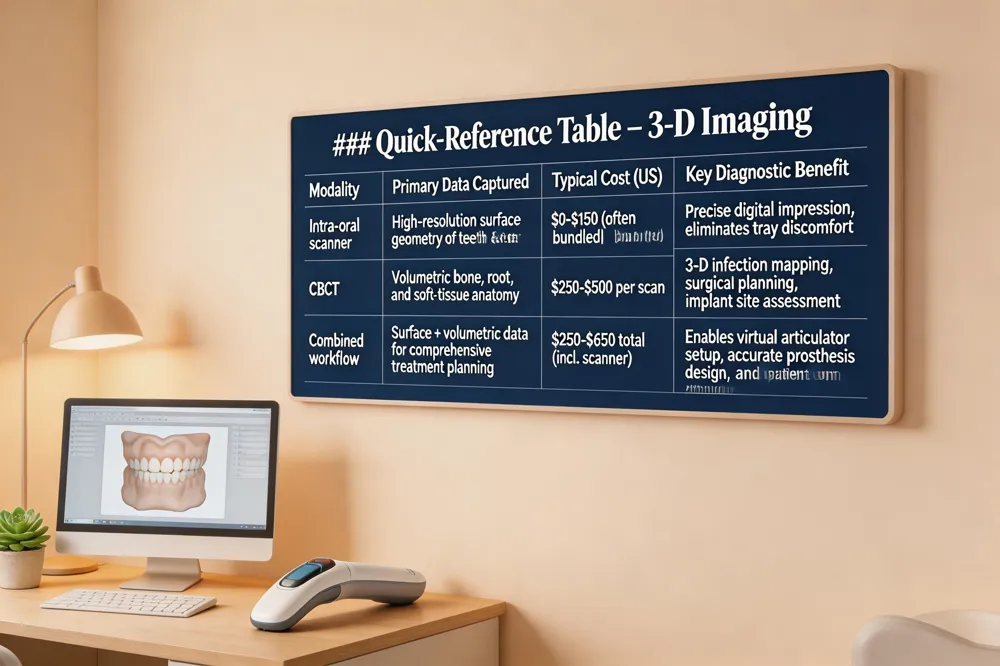 Modern intra‑oral scanners and cone‑beam computed tomography (CBCT) work together to give a complete 3‑D view of teeth, soft tissue, and bite relationships. An intra‑oral scan captures high‑resolution surface data in seconds, while CBCT adds volumetric insight into bone, roots, and surrounding anatomy.
Cost considerations: A typical CBCT exam in the United States ranges from $250 to $500, depending on case complexity and whether additional views are needed. Many practices, such as Southern Boulevard Dental, may charge a modest fee for digital delivery of the images. Insurance coverage varies, so it’s wise to request an estimate and verify benefits before the appointment.
Diagnostic power for infection detection: Unlike 2‑D x‑rays, CBCT can locate the exact extent of an infection, showing involvement of bone and soft tissue. This three‑dimensional detail helps clinicians plan precise endodontic or surgical treatment, improving outcomes and patient confidence.
Designing Digitally: From Data to Treatment Plan
Digital Workflow Overview
| Step | Tool/Software | Output | Clinical Impact |
|---|---|---|---|
| Scan acquisition | Intra‑oral scanner | STL/OBJ file | Accurate anatomy capture |
| Cloud‑based CAD | CAD platform (e.g., exocad) | Virtual design, smile‑design parameters (50‑40‑30 rule) | Predictable aesthetics, efficient collaboration |
| Virtual articulator | Integrated CAD module | Occlusal simulation | Precise bite registration, reduced adjustments |
| CAM preparation | CAM software | Milling/printing file (G‑code) | Streamlined fabrication, single‑visit restorations |
| Fit verification | In‑office scanner or printed model | Updated STL | Immediate quality control, patient satisfaction |
Key Design Rule – 50‑40‑30: Central incisors 50 % of visible width, laterals 40 %, canines 30 %.
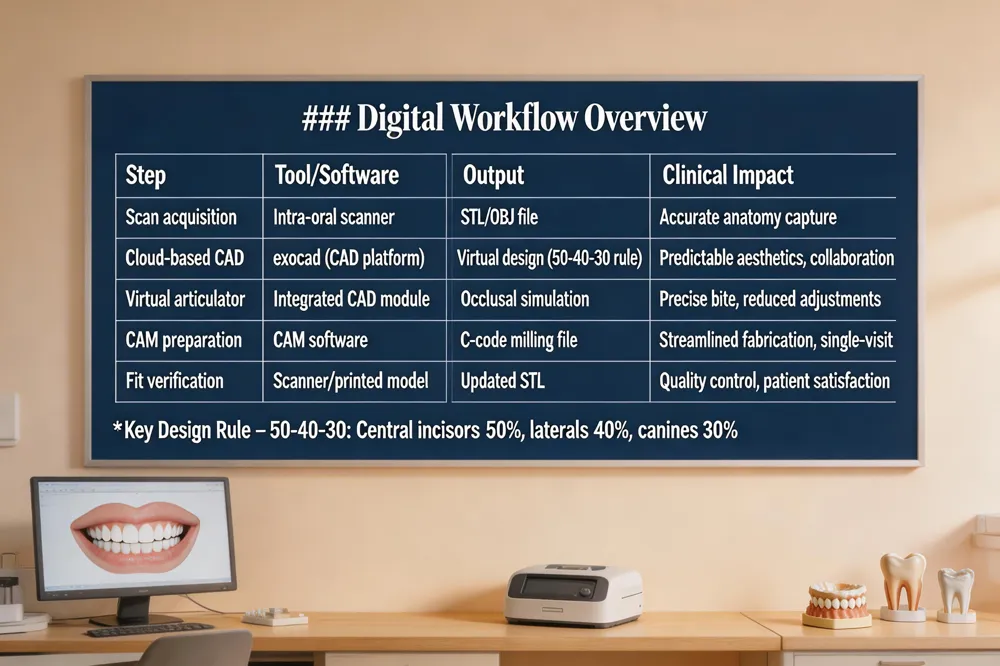 A digital workflow in dentistry integrates intra‑oral scanning, cloud‑based software, Computer‑Aided Design (CAD) software, and CAM fabrication into a seamless, patient‑friendly process. The workflow begins with a high‑resolution 3‑D scan that captures teeth, soft tissue, and bite relationships, eliminating traditional impression materials. Using Computer‑Aided Design (CAD) software, clinicians can align arches, set a virtual articulator, and apply digital smile design principles—such as the 50‑40‑30 rule, which guides the proportional width of central incisors (50 %), lateral incisors (40 %) and canines (30 %) for a harmonious aesthetic. Once the design is approved, the file is sent to an in‑house mill or 3‑D printer, where the restoration is fabricated, inspected, and placed in a single visit.
What is an example of a digital workflow in dentistry? An example starts with an intra‑oral scanner, the to cloud software for CAD design, then CAM milling/printing, followed by fit verification and placement—all recorded in the practice‑management system.
What is the 50‑40‑30 rule in dentistry? It is a visual guideline for smile design that allocates 50 % of the visible front‑tooth width to the central incisors, 40 % to the lateral incisors, and 30 % to the canines, ensuring balanced, natural‑looking proportions.
What is digital workflow in dentistry? It is the end‑to‑end digital chain that captures, plans, designs, and manufactures restorations using scanners, CAD/CAM, and additive or subtractive manufacturing, reducing chair time, errors, and improving patient comfort.
From Design to Manufacturing: CAD/CAM in Action
CAD/CAM Decision Matrix
| Material | Indication | Strength (MPa) | Translucency | Typical Use |
|---|---|---|---|---|
| Monolithic zirconia | Posterior crowns, high‑load bridges | >900 | Low–medium | Maximum durability |
| Lithium disilicate | Anterior veneers, esthetic crowns | ~370 | High | Superior aesthetics |
| Layered ceramics | Premium esthetic cases requiring graded translucency | 300‑500 | Very high | Customized shade blending |
CAM Planning Tips: Nest parts to minimize material waste, select toolpaths that avoid chatter, and perform floss‑pass proximal checks on printed models before milling.
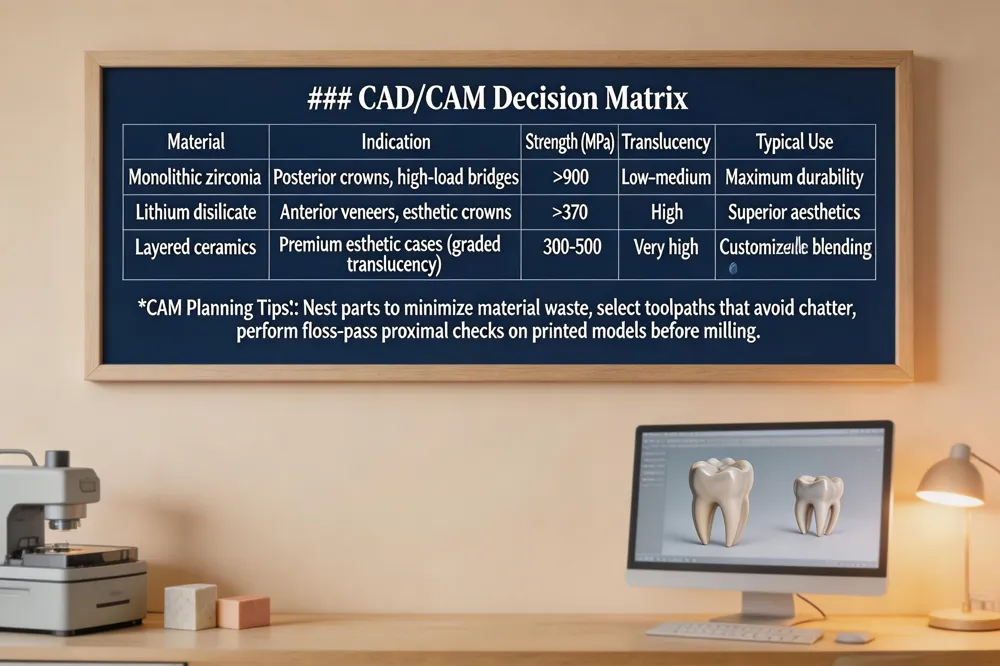 After the intra‑oral scan is verified, the dental lab uses CAD software to align the upper and lower arches and set up a virtual articulator that mimics the patient’s bite. This step guarantees that restorations fit precisely before any milling begins. Material is then chosen according to the functional intent of the case: monolithic zirconia for maximum strength in posterior crowns, lithium disilicate for superior translucency in anterior veneers, and layered ceramics when premium esthetics are required. During CAM planning the lab nests the restorations, selects optimal toolpaths and checks for chatter to protect margins. Final quality control includes fit verification on printed models, floss‑pass proximal checks and occlusion tests with shimstock. The 2‑2‑2 rule reinforces oral health: brush twice a day for two minutes and visit the dentist twice a year for professional cleanings and exams.
Patient‑Centered Benefits: Comfort, Time, and Cost
Patient Impact Summary
| Metric | Traditional Workflow | Digital Workflow | Benefit |
|---|---|---|---|
| Number of appointments | 2‑3 (impression, try‑in, delivery) | 1 (scan → design → milling → placement) | Less chair time, higher comfort |
| Impression discomfort | High (tray, material) | Low (scanner tip) | Improved patient experience |
| Total cost range (All‑on‑4) | $30‑$60k (lab + implants) | $30‑$60k (same) but often lower lab fees due to digital efficiency | Comparable cost, faster turnaround |
| Financing options | Limited | Flexible, often bundled with digital package | Greater accessibility |
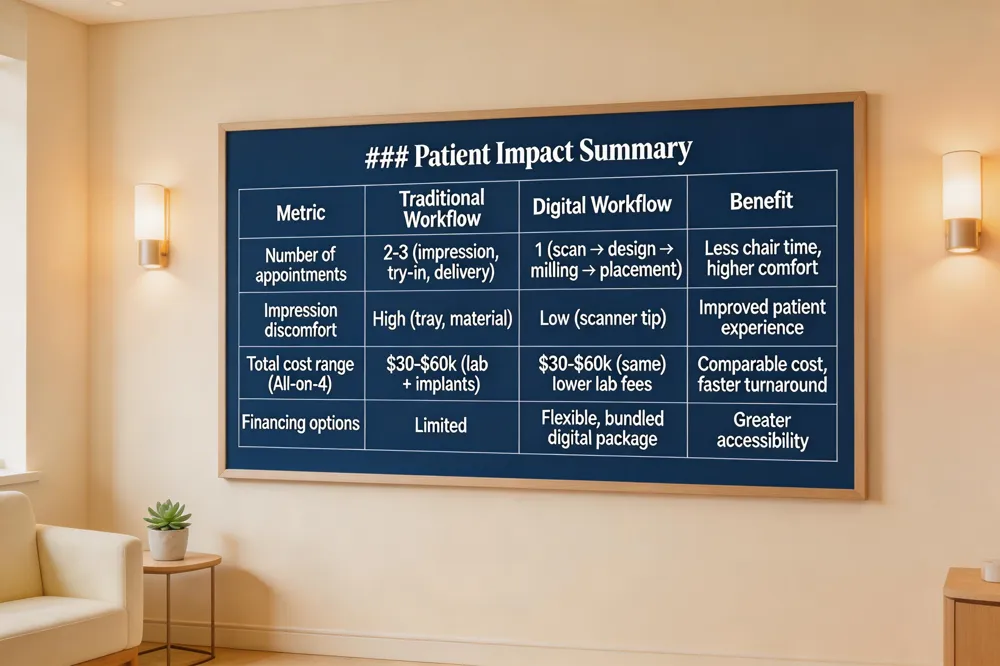 Digital dentistry transforms the patient experience by dramatically cutting the number of appointments. With intra‑oral scanning, CAD design and chair‑side milling, many restorations—crowns, bridges, or full‑arch prostheses—can be completed in a single visit, eliminating the discomfort of impression trays and reducing chair time. For a full‑mouth rehabilitation, the financial picture varies: a typical All‑on‑4 implant case ranges from $30,000 to $60,000, while more extensive All‑on‑6 or high‑end zirconia options can reach $70,000 or more; individualized implant plans may exceed $90,000. Costs depend on case complexity, implant count, material choice, and laboratory fees, but most practices offer flexible financing. The streamlined digital workflow also boosts practice efficiency—labs receive open‑format STL files with clear labeling, CAD software optimizes material use, and quality‑control checks (fit verification, shade matching) minimize remakes. The result is higher patient satisfaction, fewer follow‑up visits, and a smoother, more predictable treatment journey.
Feedback Loop and Continuous Improvement
Post‑Placement Feedback Loop
| Action | Data Captured | Platform | Outcome |
|---|---|---|---|
| Try‑in photography | High‑resolution images | Cloud case file | Visual verification of aesthetics |
| Bite scan after placement | Updated STL | Lab & clinician portal | Checks marginal fit, occlusion, proximal contacts |
| Shade verification | Calibrated lighting + cross‑polarized photos | Lab QC system | Consistent color match, reduced remakes |
| Incentive program | Submission metadata | Lab incentive dashboard | Faster turnaround, higher quality submissions |
Result: Fewer remakes, shorter chair time, continuous workflow refinement.
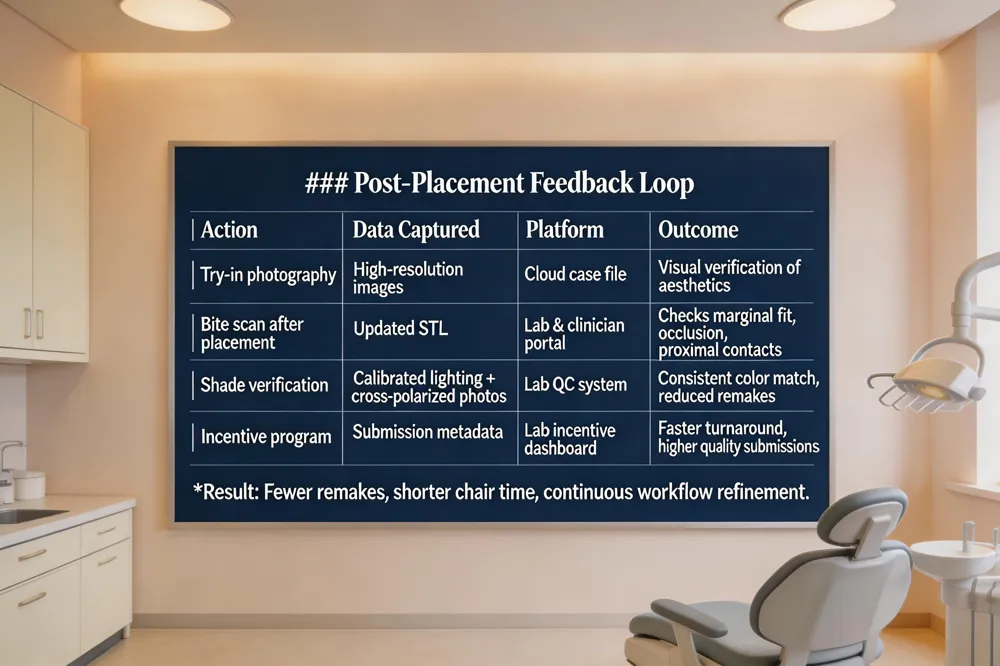 After a restoration is placed, the digital loop continues with systematic documentation. Clinicians capture high‑resolution try‑in photographs and a fresh intra‑oral bite scan, uploading both to the cloud‑based case file. These images let the laboratory verify marginal fit, proximal contacts and occlusion, and, when needed, send precise adjustment instructions back to the practice. Shade verification follows a standardized protocol: restorations are examined under calibrated lighting and cross‑polarized photography, ensuring the final color matches the patient’s dentition. Consistent lighting eliminates subjective bias and speeds final approval. Seamless lab‑practice communication is reinforced by open‑format file exchanges (STL, OBJ) and clear labeling, while incentive programs—such as Next Dental Lab’s $50 credit for first‑case submissions—encourage rapid case turnover and high‑quality outcomes. This feedback loop reduces remakes, shortens chair time, and continuously refines the digital workflow for future cases.
Future Trends and Integrated Patient Journeys
Emerging Technologies Snapshot
| Technology | Function | Clinical Advantage |
|---|---|---|
| AI‑driven smile design | Automatic analysis of scans, CBCT, facial photos | Faster case acceptance, personalized aesthetics |
| Dynamic navigation & 3‑D printed surgical guides | Real‑time implant placement | Higher accuracy, reduced operative time |
| Fully digital denture workflow | Scanning + 3‑D printing of complete dentures | Same‑day delivery, improved fit |
| Cloud‑based practice management (HIPAA‑compliant) | Secure storage & sharing of STL/OBJ, records | Seamless lab‑practice communication, automated reminders |
Patient Journey Impact: Integrated digital touchpoints create a smoother, more predictable treatment experience from diagnosis through follow‑up.
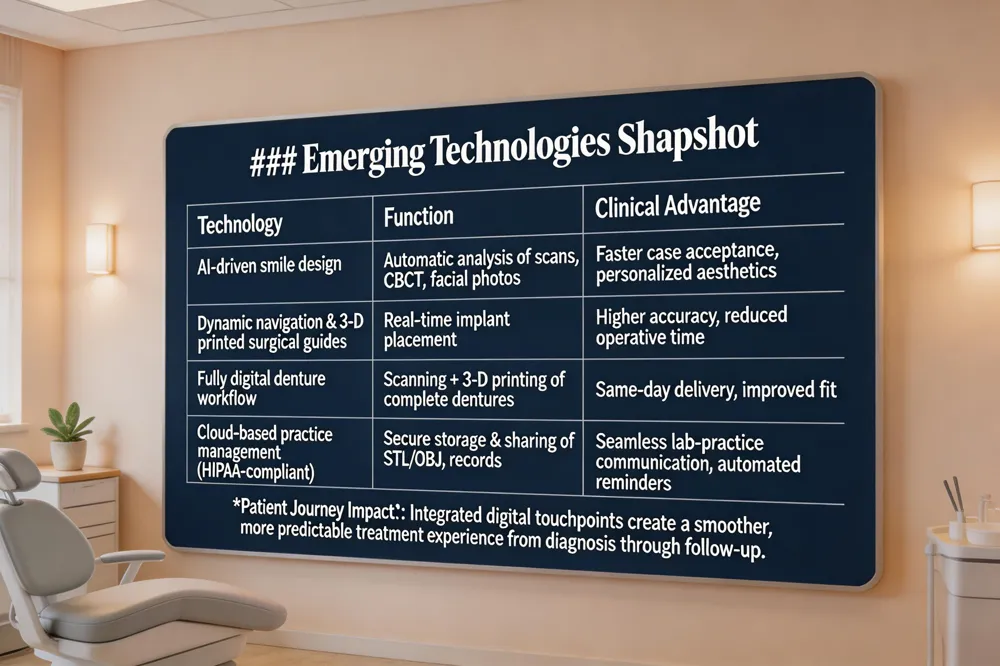 AI‑driven treatment planning is reshaping virtual smile design by instantly analyzing intra‑oral scans, CBCT data, and facial photographs to propose optimal tooth anatomy, shade, and occlusion. These algorithms suggest restorative materials—monolithic zirconia for strength, lithium disilicate for translucency—while allowing patients to preview the final aesthetic on a tablet, increasing case acceptance. Cloud‑based practice management platforms now store STL, OBJ, and patient records in HIPAA‑compliant servers, enabling seamless, secure sharing with labs and specialists and automating appointment reminders, consent forms, and post‑procedure follow‑up. Emerging tools such as dynamic navigation systems, 3‑D printed surgical guides, and fully digital denture workflows further streamline care: real‑time implant placement, precise guided surgery, and same‑day milled or printed dentures reduce chair time, enhance accuracy, and create a smoother, patient‑centered journey.
The Digital Path Forward
At Southern Boulevard Dental the digital workflow begins with a fast, intra‑oral scan that captures teeth, soft tissue and bite in seconds. The data is instantly uploaded to cloud‑based CAD software where the dentist designs crowns, bridges or implant abutments, visualizing the final result on a tablet for the patient. Because the design is digital, restorations can be milled or 3‑D printed on‑site, allowing same‑day placement and eliminating temporary prostheses. Patients enjoy a painless, tray‑free impression and fewer office visits, which reduces anxiety and improves satisfaction. Ongoing investment in high‑resolution scanners, AI‑assisted design tools and advanced milling units keeps Southern Boulevard Dental at the forefront of digital dentistry, delivering accurate, comfortable and lasting results for family member seeking modern care.