

Introduction
Understanding CBCT Technology
Cone Beam Computed Tomography (CBCT) creates detailed 3D images of teeth, bone, and nerves in a single scan—often completed in under a minute. Unlike traditional X-rays, CBCT eliminates distortion and provides clearer diagnostic views. The radiation dose is low and carefully managed, making it a safe, painless option for advanced imaging.
A Growing Standard in Everyday Dentistry
CBCT is quickly becoming a routine tool for general dentists, not just specialists. Its ability to improve treatment planning, reduce surgical risks, and enhance patient communication makes it invaluable for implants, orthodontics, and root canals. This shift brings more precise, efficient care to everyday practice.
Understanding CBCT: Definition and Clinical Uses
What is CBCT, and how is it used in dentistry?
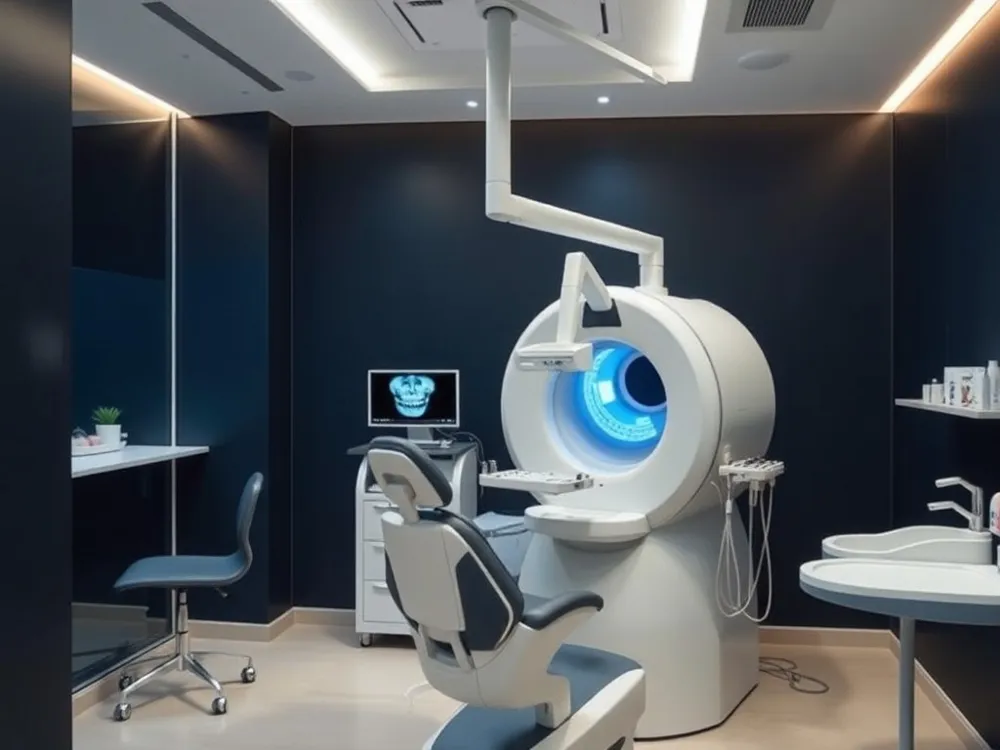
Cone Beam Computed Tomography (CBCT) is a specialized dental X‑ray technology that creates detailed three‑dimensional images of teeth, soft tissues, nerve pathways, and bone in a single scan. Unlike conventional two‑dimensional X‑rays, CBCT provides comprehensive volumetric data, allowing clinicians to view structures from any angle without superimposition.
CBCT is used when standard dental X‑rays are insufficient for diagnosis or treatment planning. Common clinical applications include precise planning for dental implants, surgical planning for impacted teeth, assessment of temporomandibular joint (TMJ) disorders, evaluation of jaw tumors, sinus analysis, and orthodontic case evaluation. The technology also aids in endodontic diagnosis by revealing complex root canal anatomy and hidden fractures. Importantly, CBCT delivers lower radiation exposure than medical CT while providing high‑resolution bone imaging, making it a safe and effective tool for complex dental care.
What are the basic principles and history of CBCT in dentistry?
CBCT operates on a simple principle: a cone‑shaped X‑ray beam rotates around the patient’s head (180°–360°) in a single revolution, capturing 150–600 two‑dimensional basis images. These are reconstructed into a three‑dimensional digital volume, enabling accurate measurements and multiplanar views. Scan times range from 5 to 40 seconds, and the effective radiation dose is typically 29–477 µSv—much lower than conventional medical CT.
CBCT’s dental history began in the late 1990s when Yoshinori Arai and colleagues in Japan developed the first dedicated dental CBCT prototype, the 3D Accuitomo. In 2001, the NewTom 9000 became the first commercial dental CBCT system in the United States. Since then, advancements in detector technology, low‑dose protocols, and software integration have made CBCT an indispensable diagnostic tool in modern dentistry.
Key Dental Specialties Leveraging CBCT
What field of dentistry benefits most from CBCT imaging?
Oral and maxillofacial surgery is widely considered the specialty that gains the most from CBCT. It enables precise 3D measurements of injuries and critical structures that two‑dimensional X‑rays cannot provide. Implantology is equally dependent on CBCT, as it allows detailed evaluation of bone quality and quantity for optimal implant placement.
Specific applications across specialties
Endodontics benefits from CBCT's ability to visualize complex root canal anatomy, detect hidden canals, and identify apical pathologies. Orthodontics uses CBCT to assess impacted teeth, root orientation, and craniofacial structures for accurate treatment planning. Periodontology and TMJ assessment also leverage CBCT for detailed bone defect analysis and joint evaluation. While multiple fields rely on CBCT, oral surgery and implantology remain among the most dependent on its advanced 3D capabilities.
CBCT vs. Traditional Imaging
What is the difference between CBCT and OPG (panoramic X-ray)?
Cone-beam computed tomography (CBCT) creates detailed three‑dimensional (3D) images of teeth, bone, nerves, and sinuses with sub‑millimeter accuracy (voxel size down to 0.09 mm). This makes it ideal for implant planning, complex endodontic assessment, and oral surgery. In contrast, an orthopantomogram (OPG) provides a two‑dimensional panoramic view of the entire mouth, which is faster and uses less radiation, making it suitable for routine check‑ups, wisdom tooth evaluation, and general orthodontic screening. While OPG requires a fixed patient position, CBCT allows imaging from multiple angles without repositioning. The choice depends on clinical need: OPG for low‑dose overviews, CBCT for precise 3D analysis when traditional X‑rays are insufficient.
What is the radiation dose of a dental cone beam CT scan compared to a panoramic X-ray?
A dental CBCT scan delivers a radiation dose ranging from about 19 to 1,073 µSv, which is higher than a panoramic X‑ray (5–25 µSv) but significantly lower than a conventional medical CT scan. Because children are more sensitive to ionizing radiation, the ADA and FDA recommend using CBCT only when clinically necessary and following the ALARA (as low as reasonably achievable) principle. Your dentist will ensure the diagnostic benefit of detailed 3D imaging outweighs the small additional risk.
Practical Considerations: Cost, Insurance, and Safety
What is the typical price of a CBCT dental scan?
The typical cost of a CBCT dental scan in the United States ranges from $100 to $500 per scan. The final price depends on the scan's complexity, your geographic location, and whether it is part of a larger treatment plan. While more expensive than a standard x‑ray, the investment reflects the detailed 3D data that allows for precise, personalized treatment planning.
Many dental practices offer financing options or payment plans to make this advanced diagnostic tool more accessible. It is always a good idea to ask your provider for a specific cost estimate before the procedure.
Is a cone beam CT scan covered by dental insurance in the United States?
Coverage for CBCT scans by dental insurance is often tied to medical necessity. Many insurers, including Delta Dental as of January 1, 2024, cover CBCT for specific procedures like implant placement, surgical extractions, or when diagnosing infections or lesions.
Routine use for simple procedures is typically not covered, and pre‑authorization may be required. Patients should check with their provider to understand their specific benefits and any required documentation. In some cases, plans may reimburse through medical codes if the scan is deemed medically necessary.
Is it safe to have a CBCT scan during pregnancy?
CBCT scans during pregnancy are generally avoided as a precaution, especially during the first trimester. However, the fetal dose from a dental CBCT is extremely low—typically between 0.009 and 7.97 µSv. To put this in perspective, this is less than the radiation you naturally receive from the environment in a single day.
According to the IAEA, the associated cancer risk from such a dose is thousands of times lower than the baseline childhood cancer risk. If a dental CBCT is medically essential, it can be performed with proper safety measures, such as using a lead apron and thyroid shield. The decision should always involve consulting with both your dentist and your obstetrician.
Integrating CBCT into Clinical Workflow
How do you interpret basic CBCT images and integrate them into dental practice?
Basic CBCT interpretation begins with a systematic review of axial, coronal, and sagittal slices. This allows you to assess bone density, tooth morphology, and the course of critical structures like the inferior alveolar nerve. Practitioners must also identify incidental findings, such as sinus pathologies. Integrating this 3D data into practice enhances precision for implant placement, orthodontic planning, and guided surgery. However, effective use requires dedicated training and ongoing education.
What are the best research and review resources on CBCT in dentistry?
Key resources include the open-access article "Cone beam computed tomography: basics and applications in dentistry" (Venkatesh, 2017) on PubMed Central. The American Association of Endodontists’ article "CBCT: Dispelling the Fear" also offers evidence-based insights. For further research, PubMed remains an essential database for peer-reviewed studies on CBCT applications across implantology, endodontics, and oral surgery.
What are the advantages and disadvantages of CBCT in dentistry?
Advantages include high‑resolution 3D imaging, detailed bone visualization, and a lower radiation dose compared to medical CT. Disadvantages involve poor soft‑tissue contrast, susceptibility to metal artifacts, and higher radiation than standard 2D X‑rays. Proper training and adherence to protocols like ALARA are essential to maximize benefits while minimizing risks.
Beyond Imaging: ROI, Patient Communication, and Future Trends
How Can CBCT Deliver a Strong Return on Investment?
A CBCT unit costs $75,000+, but with regular implant and endodontic cases, you can earn $48,000 annually from scans alone. Careful case selection ensures a quick return while expanding your service menu.
How Does 3D Imaging Improve Patient Communication?
CBCT’s 3D visuals let you show patients bone density, nerve paths, and impacted teeth. This builds trust and understanding, increasing case acceptance by 10–20%. Patients see the need for treatment clearly.
How Are AI and Digital Integration Changing CBCT?
AI platforms like Overjet automatically detect conditions on CBCT scans, reducing diagnostic fatigue and standardizing interpretation. CBCT data also integrates with CAD/CAM and digital impressions for same‑day restorations and guided surgery.
How Do Low‑Dose Protocols Keep Patients Safe?
Ultra‑low‑dose CBCT can reduce radiation by up to 87%, often reaching levels below a panoramic X‑ray. Dentists follow ALARA/ALADA principles, using the smallest field of view and lowest settings for each diagnostic need, ensuring maximal patient safety.
Conclusion
Cone-beam CT has become the gold standard for three‑dimensional imaging in dentistry. It delivers clearer views of teeth, bone, and nerves than traditional X‑rays, with lower radiation than medical CT. From implant planning to endodontics and orthodontics, CBCT enables more accurate diagnoses and safer, more predictable treatments—all in a quick, painless scan.
Southern Boulevard Dental is proud to bring this advanced technology to Rio Rancho. By integrating CBCT into our family‑focused practice, we can tailor treatment plans with greater precision and help you understand every step of your care. Ask us how CBCT can make your next visit smoother, safer, and more comfortable.