Introduction
Modern dental imaging has moved far beyond traditional film radiographs. Cone Beam Computed Tomography (CBCT) creates high‑resolution three‑dimensional views of teeth, bone, nerves and soft tissues in a single, quick scan, while digital radiography delivers instant, high‑quality 2‑D images with up to 90 % less radiation than film. Together, these technologies give dentists a comprehensive, low‑dose picture that improves diagnosis and treatment planning for implants, orthodontics, endodontics and TMJ disorders. At Southern Boulevard Dental in Rio Rancho, NM, this advanced imaging is woven into a patient‑centered workflow. The team explains each step, uses the smallest appropriate field of view to minimize exposure, and stores images securely for easy access—ensuring comfort, confidence and personalized care for every family member.
What Is a CBCT Scan and How It’s Used
CBCT Scan Overview
| Feature | Details |
|---|---|
| Technology | Cone‑beam X‑ray rotates 360° around the head, capturing hundreds of images |
| Image Output | 3‑D isotropic dataset; can be sliced sagittally, coronally, axially or rendered as a model |
| Scan Time | 5–30 seconds (typical) |
| Radiation | 70‑90 % lower than conventional medical CT; comparable to a few months of natural background radiation |
| Key Clinical Uses | Implant planning, endodontic assessment, orthodontic analysis, oral surgery, TMJ evaluation, tumor mapping |
| Integration | Merges with CAD/CAM for surgical guides with sub‑millimetre accuracy |
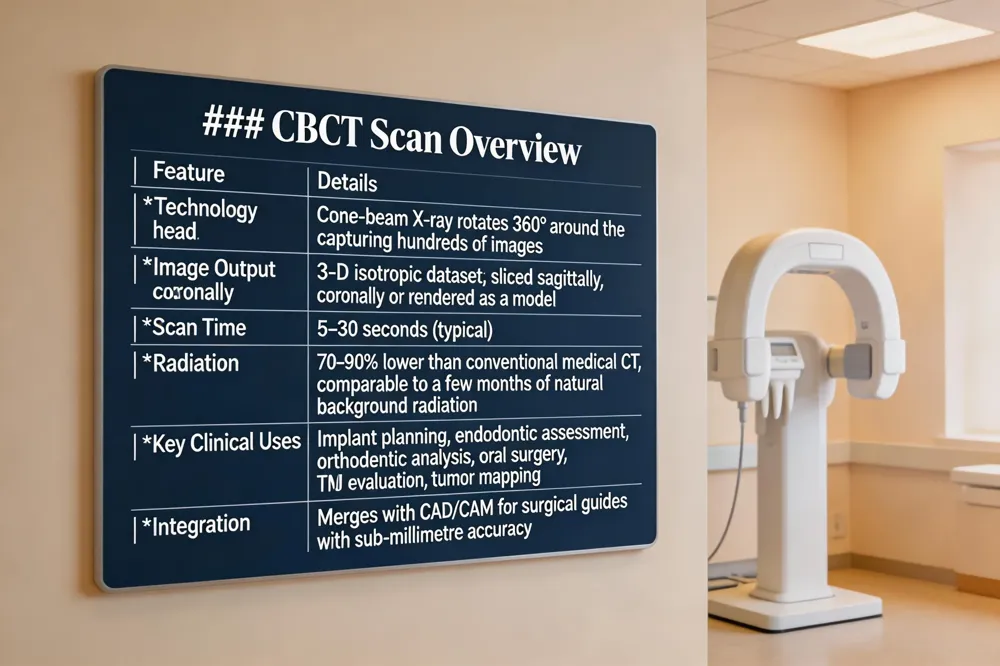 Cone Beam Computed Tomography (CBCT) is a specialized X‑ray technology that rotates a cone‑shaped beam around the patient’s head, capturing hundreds of images in a single 360° sweep. These images are reconstructed into a three‑dimensional, isotropic dataset that can be sliced in any plane (sagittal, coronal, axial) and rendered as a 3‑D model. Because the beam is focused and the scan time is typically 5‑30 seconds, radiation exposure is far lower than that of a conventional medical CT—often comparable to a few months of natural background radiation—and much lower than a full‑mouth series of traditional dental films.
CBCT is indispensable for complex dental cases. It guides implant placement by visualizing bone volume, density, and the proximity of vital structures such as the inferior alveolar nerve and maxillary sinus. In endodontics, it reveals hidden canals, vertical fractures, and periapical lesions that 2‑D radiographs miss. Orthodontists use it to assess root position, skeletal relationships, and airway space, while oral surgeons rely on it for impacted‑tooth removal, TMJ evaluation, and tumor mapping. The data can be merged with CAD/CAM software to fabricate patient‑specific surgical guides, delivering sub‑millimeter accuracy and reducing chair time.
What is a CBCT scan used for? A CBCT scan provides 3‑D images of teeth, bone, nerves, and soft tissues, supporting implant planning, orthodontic assessment, root‑canal evaluation, jaw‑pathology diagnosis, and the design of guided surgical guides.
Dental CT scan risks The primary risk is ionizing radiation, though CBCT doses are 70‑90 % lower than conventional CT. Metal artefacts and rare contrast‑media reactions may affect image quality.
Can I eat before a CBCT scan? No fasting is required. Eat normally, brush and floss before your appointment, and wear comfortable clothing. The scan is non‑invasive and does not interfere with meals or medications.
CBCT scan price Costs range from $100 to $500, with higher fees for larger fields of view or complex cases. Insurance may cover medically justified scans; Southern Boulevard Dental offers competitive pricing and will verify benefits prior to treatment.
Radiation Dose, Safety, and ALARA Principles
Radiation Dose & Safety
| Parameter | Value / Note |
|---|---|
| Effective Dose | 10–100 µSv (0.01–0.1 mSv); reported 19 µSv – 1.07 mSv depending on FOV & settings |
| Comparison | < 1/10th dose of a head/chest medical CT; higher than a single intra‑oral X‑ray but still low |
| ALARA Measures | Smallest appropriate field‑of‑view, low‑dose protocols, thyroid collars, lead aprons |
| Guidelines | ADA, FDA, specialty societies – only when diagnostic benefit outweighs risk |
| Local Practice | Southern Boulevard Dental follows strict ALARA, using ultra‑low‑dose i‑CAT technology |
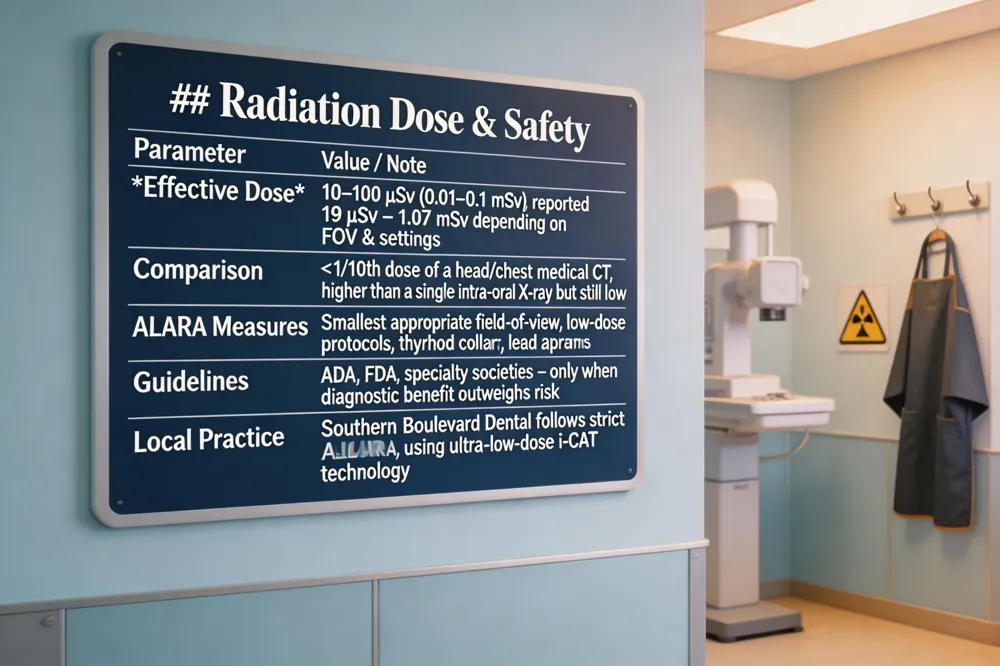 A dental cone‑beam CT (CBCT) scan typically delivers an effective dose of roughly 10–100 µSv (0.01–0.1 mSv), which is comparable to a few days of natural background radiation. Reported values vary from about 19 µSv up to 1.07 mSv, depending on the field of view, voxel size, and scanner settings. Compared with a conventional medical CT of the head or chest, CBCT provides only a fraction of the dose—often less than one‑tenth—while offering far greater anatomical detail than 2‑D radiographs. Because CBCT radiation is still higher than a single intra‑oral or panoramic X‑ray, dental professionals follow strict radiation‑safety guidelines to keep exposure as low as reasonably achievable (ALARA). This includes selecting the smallest appropriate field of view, using low‑dose protocols, and employing protective devices such as thyroid collars and lead aprons. The American Dental Association, the FDA, and specialty societies recommend that CBCT be ordered only when the diagnostic benefit outweighs the minimal risk, and that clinicians review prior images to avoid unnecessary repeat scans. By adhering to these principles, practices like Southern Boulevard Dental in Rio Rancho ensure safe, precise imaging while maintaining patient comfort and confidence.
Clinical Indications and When CBCT Is Worth It
Clinical Indications & Worth
| Indication | Why CBCT is Valuable |
|---|---|
| Implant Planning | Precise bone volume, density, proximity to nerves & sinus |
| Endodontics | Detect hidden canals, vertical fractures, periapical lesions |
| Orthodontics | Assess impacted teeth, skeletal relationships, airway space |
| Oral Surgery | Map impacted teeth, TMJ, tumors, supernumerary teeth |
| Advantages | High‑resolution 3‑D, rapid acquisition (20‑40 s), lower radiation than medical CT, surgical guide creation |
| Disadvantages | Slightly higher dose than 2‑D X‑rays, higher cost, limited soft‑tissue contrast, metal artefacts |
| Worth It When | Detailed anatomy is required for accurate diagnosis & treatment planning |
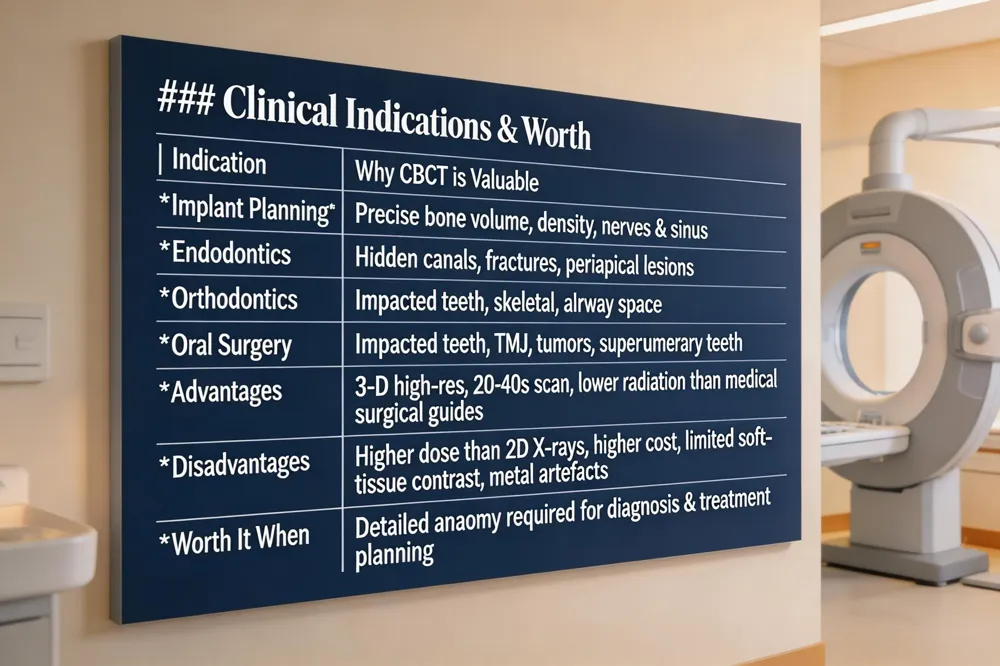 Cone‑Beam Computed Tomography (CBCT) is indicated whenever three‑dimensional imaging is required to evaluate hard tissues of the maxillofacial region. It is essential for implant planning, allowing precise measurement of bone volume, density, and proximity to vital structures such as the mandibular nerve and sinus floor. Orthodontists rely on CBCT to assess impacted teeth, skeletal discrepancies, and airway dimensions, while endodontists use it to detect hidden canals, periapical lesions, and root fractures that 2‑D radiographs miss. CBCT also aids in diagnosing oral lesions, TMJ disorders, and planning surgical removal of supernumerary teeth.
Is a CBCT scan worth it? When a detailed view of teeth, bone, or surrounding anatomy is needed, the scan is well worth the investment. The 3‑D images reveal hidden problems, improve diagnostic accuracy, and enable virtual treatment planning, reducing retreatment risk and overall cost. The scan takes seconds, delivers radiation comparable to a few dental X‑rays, and enhances patient safety and comfort.
Advantages include high‑resolution 3‑D images, rapid (20‑40 seconds) acquisition, lower radiation than medical CT, and the ability to create precise surgical guides. Disadvantages are a modest increase in radiation over conventional X‑rays, higher cost, limited soft‑tissue contrast, potential metal artefacts, and the need for specialized interpretation.
Insurance Coverage, Cost, and Local Access in Rio Rancho
Insurance, Cost & Local Access (Rio Rancho)
| Item | Details |
|---|---|
| Typical Price | $150 – $700 (varies by FOV, voxel resolution, CAD/CAM integration) |
| Insurance | Most carriers (e.g., Delta Dental since 1 Jan 2024) reimburse when medically justified (implant, ortho, TMJ, impacted extraction) |
| Patient Pay Options | HSAs/FSAs treat CBCT as IRS‑approved dental expense |
| Local Provider | Southern Boulevard Dental Center – on‑site ultra‑low‑dose i‑CAT, 3‑5 s scan, immediate treatment planning |
| Coverage Limits | Routine cosmetic scans usually excluded; documentation of necessity required |
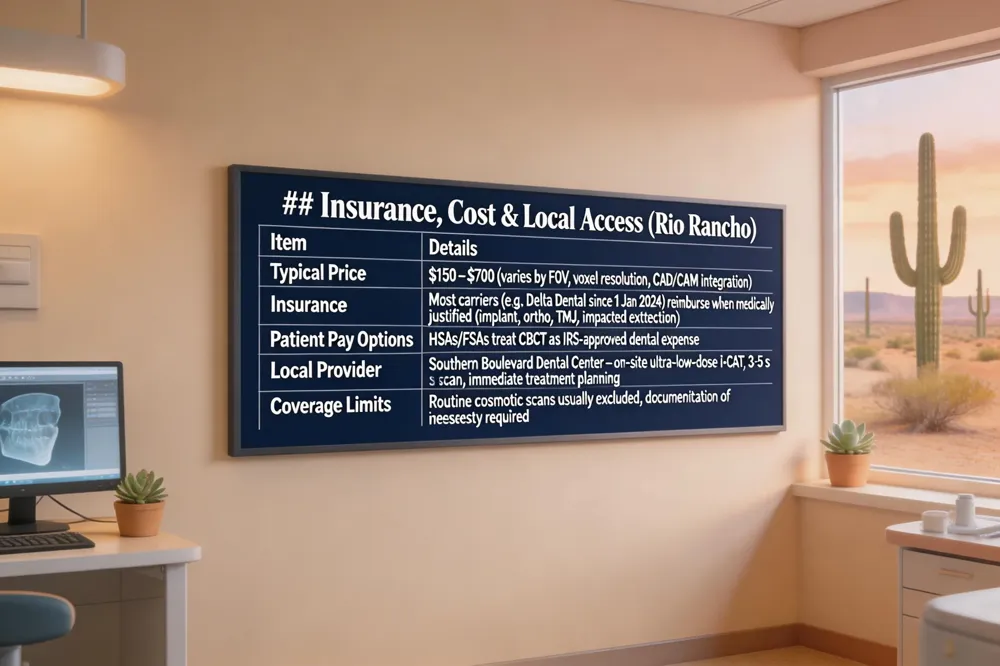 Dental insurance policies increasingly recognize Cone Beam Computed Tomography (CBCT) as a medically necessary diagnostic tool. Most carriers—such as Delta Dental, which added CBCT to its PPO coverage on January 1 2024—will reimburse the scan when it supports implant planning, orthodontic evaluation, TMJ assessment, or surgical extraction of impacted teeth. Coverage depends on the clinical indication; routine cosmetic scans are typically excluded. When dental benefits are limited, patients can use HSAs or FSAs, which treat CBCT as an IRS‑approved dental expense.
Pricing details vary by practice and scan scope. In Rio Rancho, a CBCT exam generally ranges from $150 to $700. The final cost reflects field‑of‑view size, voxel resolution, and whether the image is integrated with CAD/CAM planning. Insurance reimbursement can offset much of this fee when the provider documents medical necessity.
Neighborhood availability is convenient for local families. Southern Boulevard Dental Center in Rio Rancho offers on‑site ultra‑low‑dose CBCT using the latest i‑CAT technology. The scan takes only 3‑5 seconds, delivers high‑resolution 3‑D images, and allows immediate treatment planning—all within a patient‑centered, family‑friendly environment. Schedule an appointment to experience fast, accurate imaging close to home.
Digital Workflow Integration and Patient Education Resources
Digital Workflow & Patient Education
| Step | Process |
|---|---|
| 1. Digital X‑ray | Low‑dose, instant image acquisition; enhanced, stored, shared immediately |
| 2. CBCT Capture | 3‑D volumetric data collected when needed |
| 3. CAD/CAM Integration | Data imported to design surgical guides, orthodontic appliances, prosthetics |
| 4. 3‑D Printing | Patient‑specific guides/appliances printed on‑site |
| 5. Patient Communication | PDFs & PowerPoints explaining physics, safety (ALARA), FOV selection, clinical indications |
| Benefit | Faster chair time, higher accuracy, informed shared decision‑making |
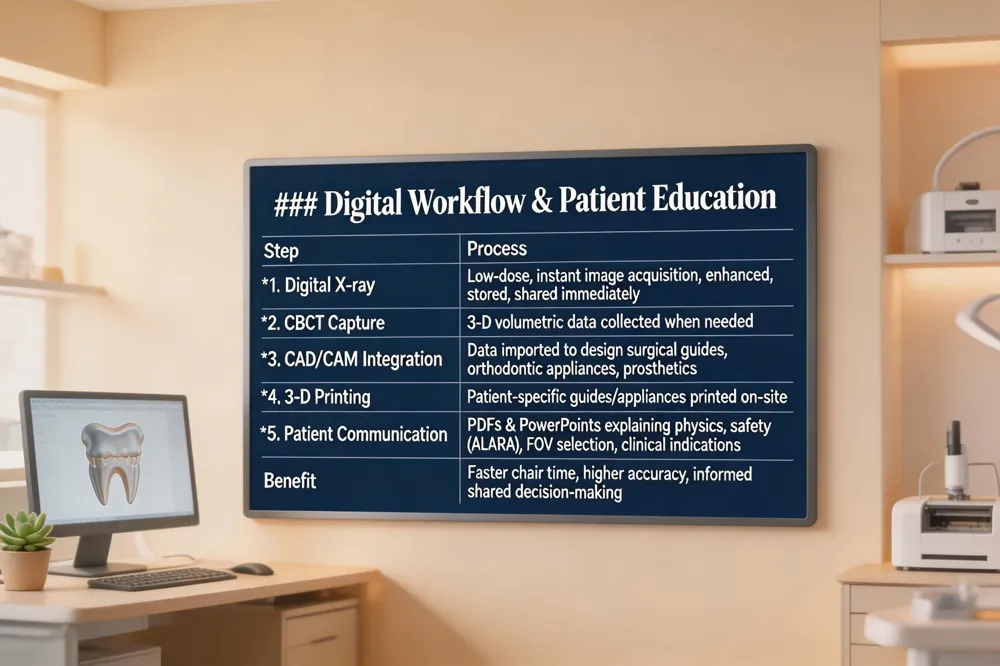 Modern dental practices like Southern Boulevard Dental blend digital radiography, CAD/CAM, and 3‑D printing into a seamless workflow that puts patients at the center of care. Instant, low‑dose digital X‑rays provide high‑quality images that can be enhanced, stored, and shared with patients during the same visit, allowing immediate discussion of findings. When a case requires three‑dimensional insight—such as implant planning, complex endodontic diagnosis, or orthodontic evaluation—cone‑beam computed tomography (CBCT) supplies volumetric data that integrates directly with CAD/CAM software. The resulting virtual models are used to design precise surgical guides and 3‑D‑printed appliances, reducing chair time and improving accuracy. To keep patients informed, the practice offers downloadable PDFs and PowerPoint presentations that explain CBCT physics, radiation safety (ALARA), field‑of‑view selection, and clinical indications. These educational tools demystify the technology, reinforce the practice’s patient‑focused communication, and support shared decision‑making, ensuring that every treatment plan is both evidence‑based and comfortably understood.
Specialty Applications: Endodontics, Orthodontics, and Cancer Detection
Specialty Applications
| Specialty | CBCT Benefits |
|---|---|
| Endodontics | Isotropic voxels (0.09‑0.4 mm) reveal hidden canals, fractures, periapical lesions; diagnostic accuracy ↑ 30‑40 % |
| Orthodontics | True 3‑D root position, alveolar bone thickness, airway volume; radiation low (10‑30 µSv for small FOV) |
| Cancer Detection | May show bone invasion or abnormal densities; not definitive for soft‑tissue cancers – requires further imaging/biopsy |
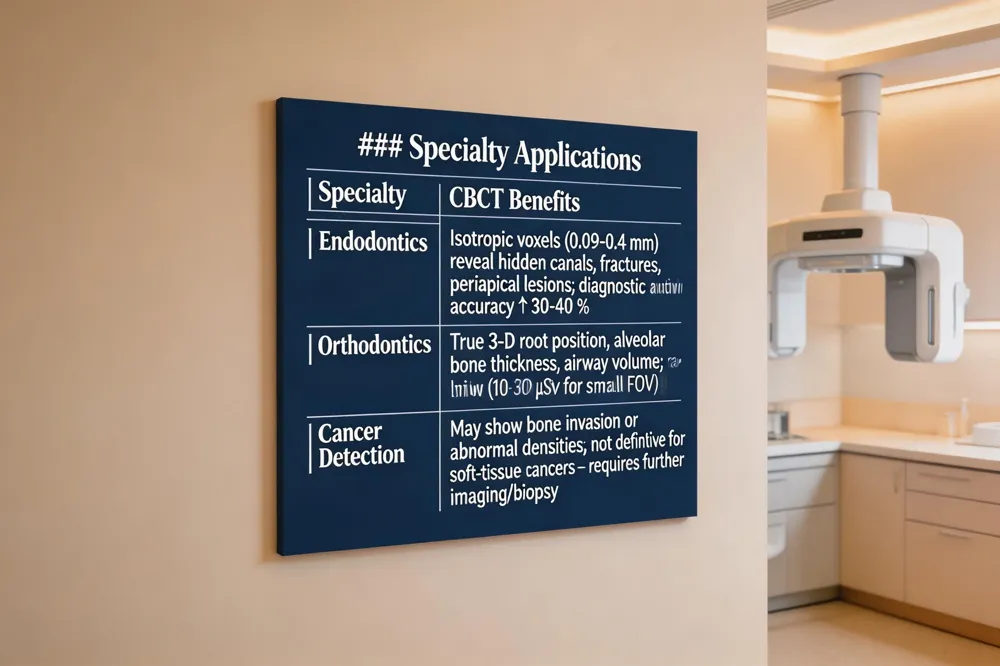 CBCT has become an essential tool for complex endodontic cases. Its isotropic voxels (0.09‑0.4 mm) allow clinicians to locate hidden canals, vertical root fractures, and small periapical lesions that often escape 2‑D radiographs, improving diagnostic accuracy by up to 30‑40 % and supporting more successful root‑canal therapy.
In orthodontics, CBCT provides true three‑dimensional data on tooth root position, alveolar bone thickness, and airway volume. By generating virtual treatment models, practitioners can plan precise tooth movements, evaluate skeletal relationships, and reduce treatment time, while the adjustable field‑of‑view keeps radiation exposure low (10‑30 µSv for a small scan).
Can CBCT scan Detect Cancer? CBCT can sometimes reveal suspicious bone or tissue changes that may indicate oral cancer, but it is not a definitive diagnostic tool for malignancy. The scan’s strength lies in visualizing three‑dimensional bone architecture, so it may highlight bone invasion or abnormal densities that warrant further investigation. However, early soft‑tissue cancers often do not produce visible structural alterations on CBCT, and the modality lacks the contrast resolution of medical CT, MRI, or PET scans. A definitive cancer diagnosis therefore requires additional imaging and a tissue biopsy. In practice, dentists use CBCT as a screening aid and to assist in treatment planning, referring patients for specialized imaging and pathology when a lesion is suspected.
Future Directions: AI, MRI, Ultrasound, and Emerging Imaging
Future Directions in Dental Imaging
| Emerging Tech | Role & Impact |
|---|---|
| Artificial Intelligence | Auto‑segmentation, lesion detection, airway analysis; improves diagnostic speed & consistency |
| Low‑field Dental MRI (≈0.55 T) | Soft‑tissue imaging without ionising radiation; ideal for TMJ, salivary glands |
| Ultrasound | Radiation‑free assessment of gingival thickness, lymph nodes, superficial tissue inflammation |
| Augmented Reality (AR) | Overlay CBCT data onto live surgical field via headsets/tablets; guides implant drilling, orthodontic force application with sub‑mm precision |
| Overall Goal | Safer, more accurate, patient‑centric diagnostics integrating AI, non‑ionising modalities, and immersive visualization |
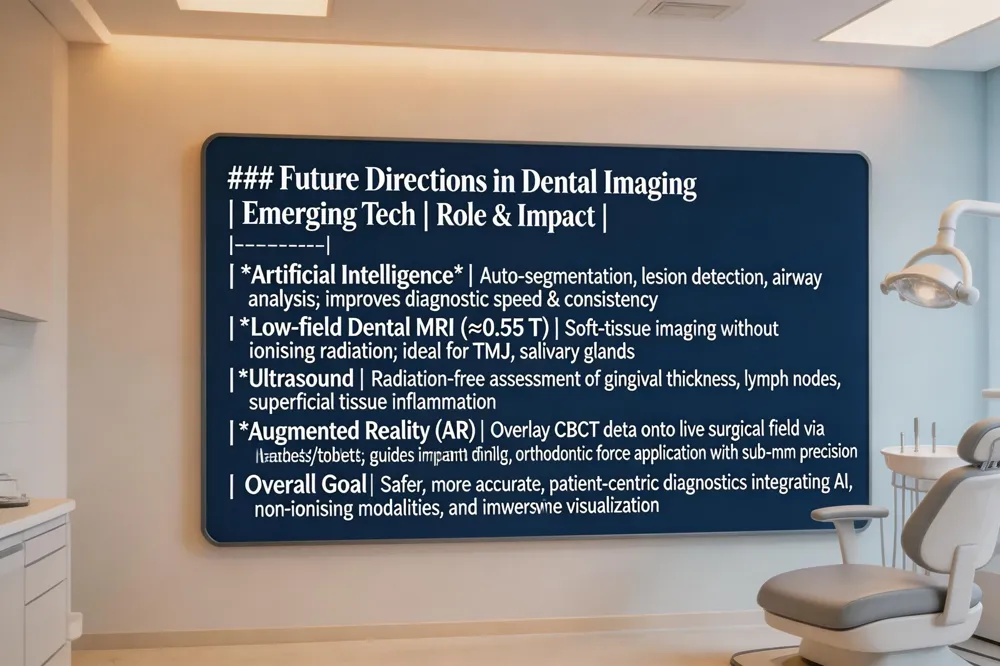 Artificial intelligence is rapidly becoming a companion to cone‑beam computed tomography in dental offices. AI algorithms can automatically segment CBCT data, flag periapical lesions, bone deficiencies, and even predict airway constriction, streamlining diagnosis and reducing clinician fatigue. In practices such as Southern Boulevard Dental in Rio Rancho, AI‑driven detection tools are being tested to enhance the 30‑40 % increase in lesion identification already reported for CBCT.
Non‑ionising imaging alternatives are also gaining traction. Low‑field dental MRI (≈0.55 T) can capture soft‑tissue detail without any ionising radiation, making it ideal for TMJ assessment and evaluating salivary‑gland pathology where CBCT’s bone‑focused contrast is limited. Ultrasound, while unable to image mineralized structures, provides a radiation‑free method for assessing superficial tissues such as gingival thickness, lymph nodes, and salivary gland inflammation.
The next frontier is integration with augmented reality (AR). By merging CBCT volumetric data with AR headsets or tablet displays, clinicians can overlay a patient’s 3‑D anatomy onto the live surgical field. This real‑time visualization guides implant drilling, orthodontic force application, and maxillofacial reconstruction with sub‑millimetre precision, reducing operative time and improving patient confidence. Together, AI, non‑ionising modalities, and AR promise a more accurate, safer, and patient‑centred future for dental diagnostics.
Conclusion
Cone‑Beam Computed Tomography has transformed dental diagnostics by delivering three‑dimensional, high‑resolution images that reveal bone, nerve pathways, root anatomy and soft‑tissue details impossible to see on traditional 2‑D X‑rays. The lower radiation dose, rapid acquisition (often under 20 seconds) and ability to integrate with CAD/CAM and 3‑D printing enable precise implant placement, accurate endodontic and orthodontic planning, and minimally invasive surgery, ultimately improving success rates and patient comfort. At Southern Boulevard Dental in Rio Rancho, we embrace these advances to provide a patient‑centered experience: same‑day CBCT imaging, virtual treatment simulations, and custom‑fabricated guides are combined with a compassionate, family‑focused approach. Our commitment is to harness cutting‑edge technology while maintaining safety, transparency and personalized care for every smile.