A New Era of Patient‑Centric Dentistry
Digital impression technology uses a handheld intra‑oral scanner that captures a high‑resolution 3‑D model of the teeth and gums in seconds, eliminating bulky trays and gooey putty. The process is quick, non‑invasive, and virtually pain‑free, which significantly reduces gag reflexes, mouth fatigue, and anxiety. Comfort is central to successful dental care because a relaxed patient cooperates better and experiences fewer post‑procedure issues. Southern Boulevard Dental in Rio Rancho embraces this technology, offering real‑time visual previews, instant electronic lab transmission, and a fully FDA‑cleared workflow. Our team prioritizes a calm, family‑friendly environment while delivering precise, same‑day restorations and lasting smiles for patients.
Understanding Digital vs. Traditional Impressions
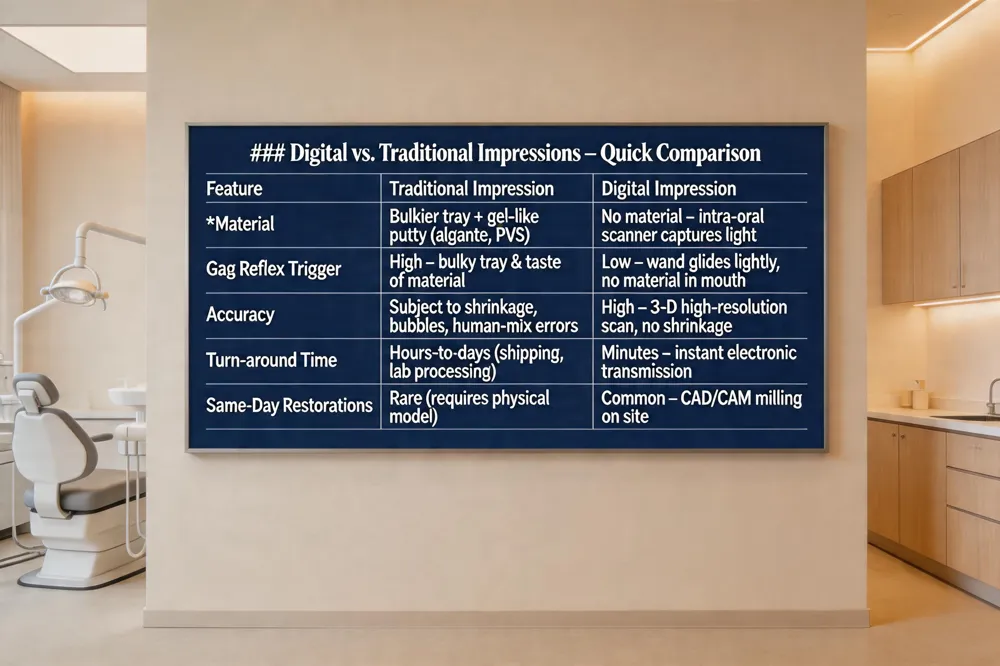
Digital vs. Traditional Impressions – Quick Comparison
| Feature | Traditional Impression | Digital Impression |
|---|---|---|
| Material | Bulkier tray + gel‑like putty (alginate, PVS, etc.) | No material – intra‑oral scanner captures light |
| Gag Reflex Trigger | High – bulky tray & taste of material | Low – wand glides lightly, no material in mouth |
| Accuracy | Subject to shrinkage, bubbles, human‑mix errors | High – 3‑D high‑resolution scan, no shrinkage |
| Turn‑around Time | Hours‑to‑days (shipping, lab processing) | Minutes – instant electronic transmission |
| Same‑Day Restorations | Rare (requires physical model) | Common – CAD/CAM milling on site |
 Traditional impressions require a bulkier tray filled with a gel‑like material (alginate, polyvinyl siloxane, etc.) that hardens in the mouth, often trigger gag reflexes and can distort when removed, leading to uncomfortable, mess‑filled procedures.
In contrast, an intra‑oral scanner wand glides lightly over the teeth, capturing a high‑resolution 3‑D image in seconds without any material in the mouth.
The digital workflow eliminates setting time, provides real‑time visual feedback, and instantly transmits the file to the lab, shortening turnaround by days to hours and often enabling same‑day milling of crowns or aligners.
Higher accuracy with digital scans, which are free from shrinkage, air bubbles, and human‑mixing errors, resulting in better‑fitting restorations and fewer repeat appointments.
What is the difference between a digital impression and a traditional impression? Traditional methods use a physical tray and putty that hardens, can cause gagging, and may warp; digital impressions use a scanner to create a precise virtual model, eliminating mess, reducing anxiety, and delivering faster, more accurate results for crowns, veneers, implants, and more.
Patient Comfort and Reduced Discomfort
Patient Comfort Benefits
| Aspect | Traditional | Digital |
|---|---|---|
| Tray Size | Bulky, fills mouth | Small handheld wand |
| Gag Trigger | Frequent due to tray & taste | Minimal – no tray, no taste |
| Procedure Time | 5‑10 min (setting + removal) | 2‑5 min scan only |
| Patient Anxiety | High (mess, gag, distortion) | Low (visual preview, quick) |
| Need for Repeat | Common (distortion, bubbles) | Rare (real‑time verification) |
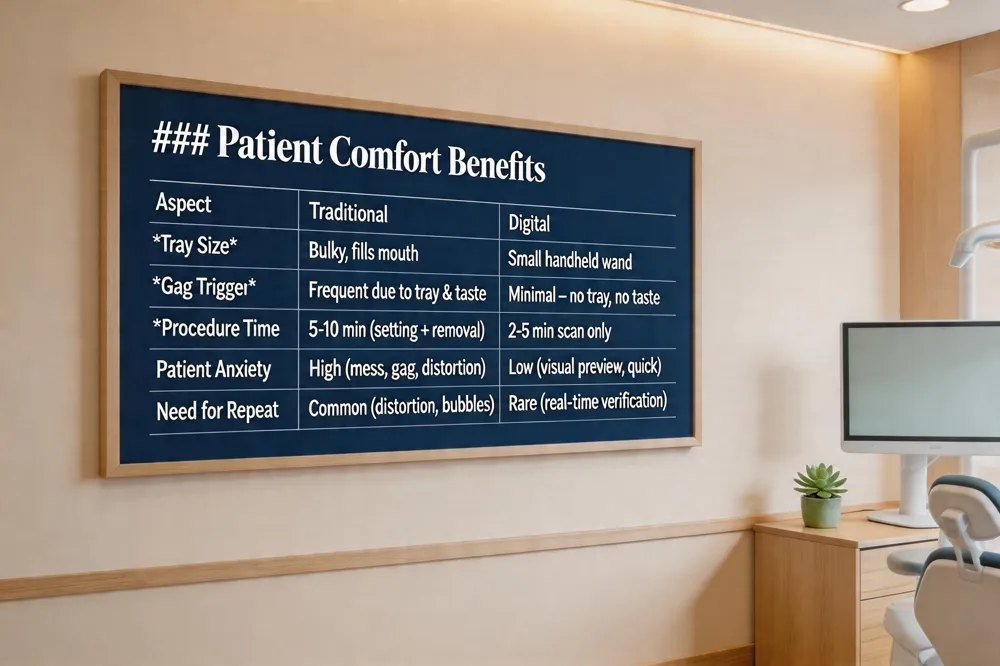 Digital intra‑oral scanners eliminate the bulky, putty‑filled trays that trigger gag reflexes in many patients. The handheld wand glides over the teeth, capturing a high‑resolution 3‑D image in just a few minutes without any material setting in the mouth, making the procedure virtually painless and non‑invasive. Because the scan is displayed instantly on a monitor, the dentist can show the patient a real‑time preview of their oral anatomy and make immediate adjustments, which reassures the patient and removes the need for repeat impressions.
What are the advantages of digital impressions? Digital impressions provide superior three‑dimensional accuracy, minimizing fit errors that can occur with traditional impression materials. They eliminate uncomfortable trays and gel‑based substances, making the procedure virtually painless for the patient. The scans are captured instantly and transmitted electronically to the laboratory, shortening turnaround time and allowing same‑day restorations through seamless CAD/CAM integration. Real‑time visualization lets the dentist evaluate and adjust the model on the spot, reducing the need for repeat appointments. Overall, the workflow is more efficient, cost‑effective, and delivers consistently high‑quality prosthetic outcomes.
Speed, Efficiency, and Same‑Day Restorations
Speed & Efficiency Summary
| Metric | Traditional Workflow | Digital Workflow |
|---|---|---|
| Chair Time (full arch) | 5‑10 min (tray set & remove) | 2‑5 min scan |
| Lab Turn‑around | Days (shipping, stone cast) | Hours – electronic file sent instantly |
| Same‑Day Capability | Uncommon (requires physical model) | Common – CAD/CAM milling on‑site |
| Appointments Needed | 2‑3 (impression, provisional, final) | 1‑2 (scan + immediate milling) |
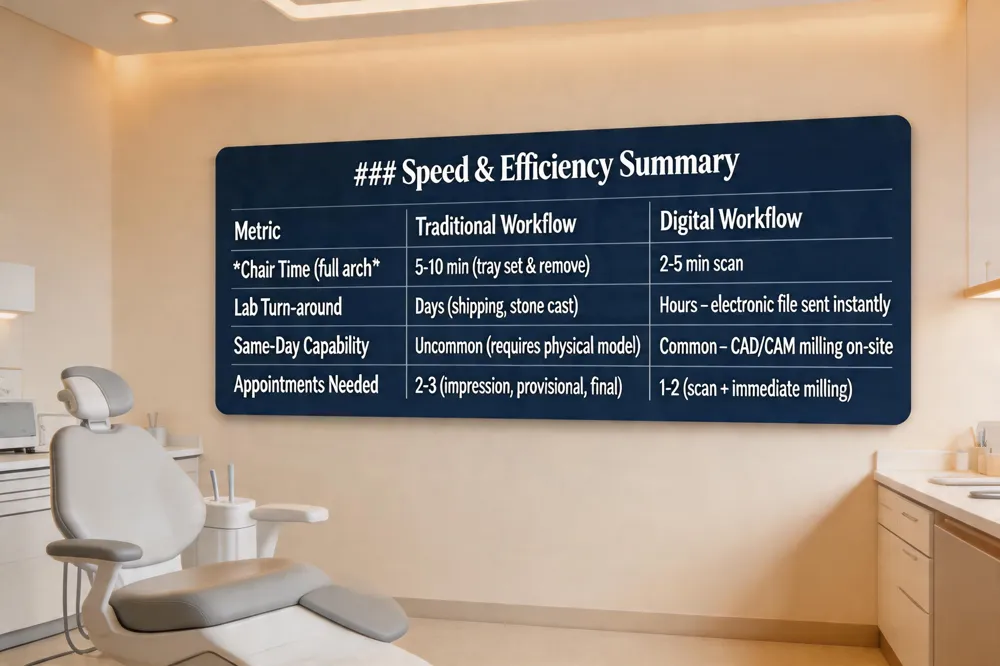 Digital intra‑oral scanners cut chair‑time dramatically: a full‑arch scan takes only 2–5 minutes, compared with the 5–10 minutes required for a traditional tray to set and be removed. Because the scan is completed in real time, the dentist can review the data on a monitor and send the file instantly to the laboratory, eliminating shipping delays and the risk of distortion. The electronic file also feeds directly into CAD/CAM software, allowing on‑site milling of crowns, bridges or even aligners. In practices that have adopted this workflow—such as Southern Boulevard Dental in Rio Rancho, NM—patients often receive a finished restoration the same day, reducing the number of appointments, minimizing discomfort, and delivering a faster, more comfortable treatment experience.
Adoption Rates and Future Trends in Dental Practice
Adoption Landscape
| Metric | Current (2024) | Projected (2026‑2028) |
|---|---|---|
| U.S. Office Adoption | 40 %‑50 % of practices | > 50 % (majority) |
| Key Drivers | Accuracy, reduced remakes, patient demand | Lower cost, EHR integration, faster workflow |
| Barriers | Up‑front equipment cost, learning curve | Continued cost reductions, training programs |
| Trend | Steady growth, tech‑savvy practices leading | Near‑future full digitization of impression taking |
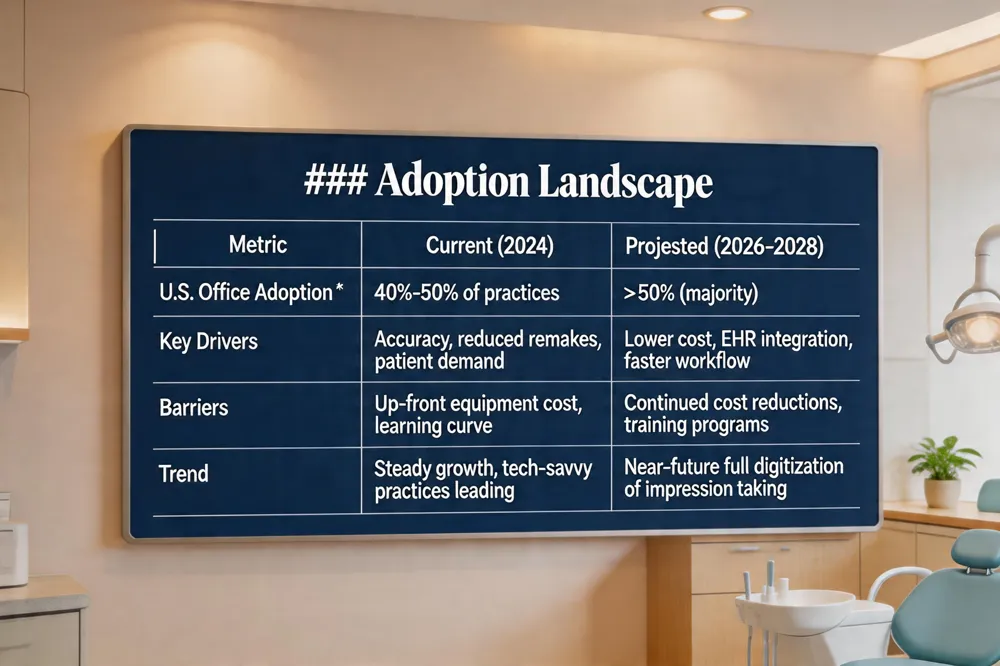 Current surveys indicate that roughly 40 %–50 % of U.S. dental offices have integrated intra‑oral scanners into their workflow, positioning digital impressions just shy of a majority. Several factors are accelerating this adoption: the scanners' high accuracy reduces the need for remakes, the streamlined digital workflow cuts chair‑time and material waste, and patient demand for a comfortable, gag‑free experience is growing. As the technology becomes more affordable and electronic health‑record integration becomes standard, practices are finding the investment increasingly justified. Industry analysts project that the adoption rate will soon surpass the 50 % threshold, with many practices expecting full‑digitization of impression taking within the next few years. In short, while most dentists are not yet using digital impressions, a substantial and rapidly expanding segment of the profession already has, and the trend points toward a near‑future majority.
Beyond Comfort: Environmental and Clinical Benefits
Environmental & Clinical Impact
| Factor | Traditional | Digital |
|---|---|---|
| Disposable Material Waste | High – trays & putty (up to 100 % waste) | Low – up to 80 % reduction in waste |
| Cross‑Contamination Risk | Higher – reusable trays, messy material | Lower – no reusable trays, no gel residue |
| Sterilization Workflow | Complex cleaning of trays & instruments | Simpler – only scanner tip requires disinfection |
| Carbon Footprint | Larger – plastic trays, shipping of casts | Smaller – digital files, minimal shipping |
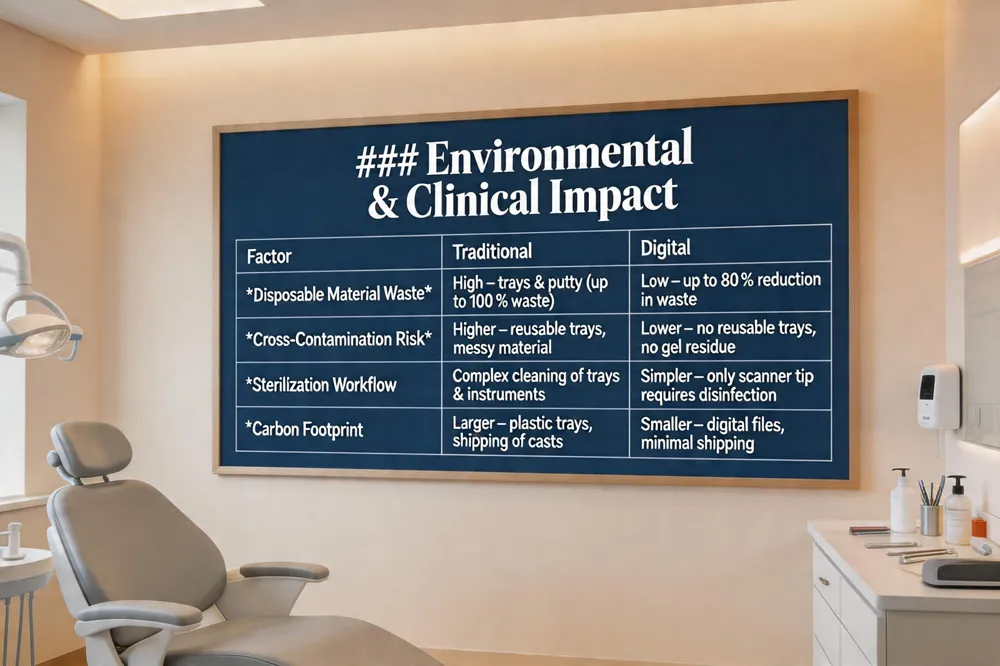 Digital intra‑oral scanners replace bulky trays and putty, cutting the volume of disposable impression material by up to 80 %. This reduction eliminates the sticky, odor‑laden gels that can trigger gag reflexes and removes a major source of cross‑contamination, a concern highlighted by the American Dental Association’s infection‑control guidelines. Because no reusable trays or impression compounds are used, clinics enjoy cleaner, more efficient sterilization workflows and a lower risk of transmitting pathogens between patients. The environmental payoff is significant: fewer plastic trays and less waste mean a smaller carbon footprint for the practice. For post‑procedure comfort, many dentists recommend the 3‑3‑3 rule—take three 200‑mg ibuprofen tablets every three hours for up to three days, unless contraindicated—to manage pain and inflammation after restorative work.
Embracing a Painless Future
Digital intra‑oral scanners capture a 3‑D image of your teeth in just a few minutes, eliminating the bulky, gag‑inducing trays and putty used in traditional impressions. The non‑invasive scan feels painless, reduces chair time, and delivers highly accurate data that results in restorations that fit on the first try, cutting the need for adjustments. At Southern Boulevard Dental in Rio Rancho, NM, our team uses FDA‑cleared scanners to provide visual feedback and electronic lab transmission, speeding up treatment and enhancing comfort. We invite you to experience the impression process and see how a digital smile can be crafted with confidence.