Introducing a New Era of Dental Communication
Visual storytelling transforms a dental visit into a clear, confidence‑building experience. When patients see a 3‑D representation of their own teeth, they grasp the problem and the proposed solution far better than with static X‑rays or verbal explanations, leading to a 30‑35% boost in comprehension and a measurable drop in anxiety. The rapid rise of augmented reality (AR) and virtual reality (VR) brings this capability into everyday practice. AR overlays digital models onto a patient’s mouth in real time, while VR offers immersive simulations of procedures, both reinforcing understanding and supporting informed‑consent discussions. Southern Boulevard Dental in Rio Rancho embraces these tools as a core part of its patient‑centered model. By pairing intra‑oral scanners with tablet‑based AR apps, the team shows each individual their treatment plan, from cavity preparation to orthodontic movement, fostering shared decision‑making, higher acceptance rates, and a reassuring, family‑focused atmosphere.
Understanding Augmented Reality in Healthcare and Dentistry
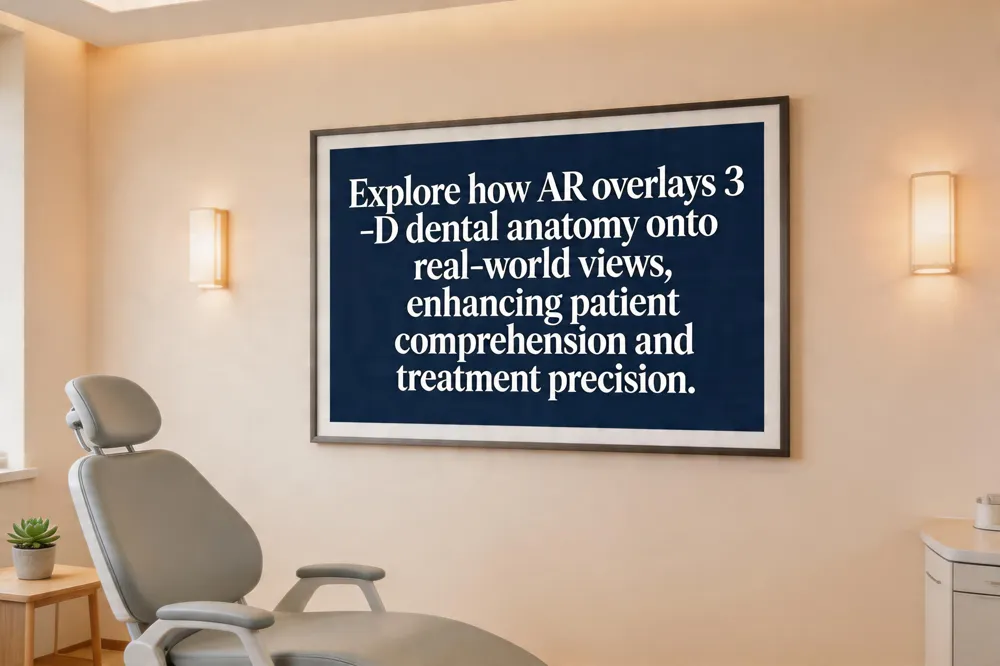 Augmented reality (AR) is a technology that overlays computer‑generated images onto the real‑world view through devices such as smartphones, tablets, or head‑mounted displays like Microsoft HoloLens and Magic Leap. In dentistry, AR can project patient‑specific 3‑D models of teeth, gums, and underlying bone directly onto a mirror, intra‑oral camera feed, or a patient’s own smile, allowing clinicians and patients to see anatomy and treatment plans in situ.
Clinically, AR improves patient understanding by up to 30 % compared with traditional 2‑D explanations, reduces anxiety, and raises treatment‑acceptance rates by 12‑15 %. Real‑time overlays guide implant placement, crown preparation, and orthodontic simulations, enhancing precision and shortening chair time. For education, AR transforms abstract concepts into interactive visualizations, boosting health literacy and post‑procedure compliance.
Regulatory agencies such as the FDA have cleared several AR devices for dental use under the 510(k) pathway, classifying them as low‑risk medical devices when used for education and treatment planning. Safety considerations include accurate tracking, low latency, and compliance with HIPAA for patient imaging data. When properly integrated with intra‑oral scanners and digital radiography, AR offers a patient‑centered, evidence‑based tool that aligns with modern, family‑friendly dental practices.
The Patient‑Education Process and AR Integration
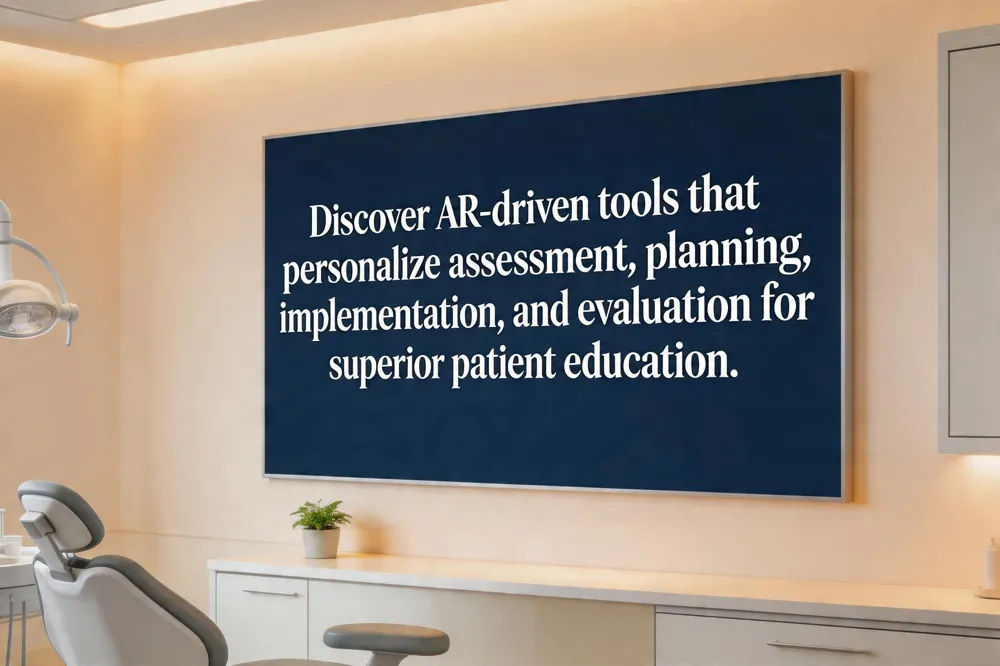 The patient‑education process is built on four equal, inter‑related components. First, assessment involves identifying the patient’s current knowledge, health‑literacy level, concerns, and learning preferences so the education can be tailored to their needs. Second, planning sets clear, realistic learning goals and selects appropriate, evidence‑based resources—such as brochures, videos, or digital tools—to match those goals. Third, implementation delivers the information using the chosen modalities, often employing techniques like teach‑back or motivational interviewing to engage the patient actively. Finally, evaluation measures the patient’s understanding and the impact of the education on outcomes, allowing the clinician to adjust the plan as needed.
How AR fulfills each component
- Assessment: AR‑enabled questionnaires on tablets instantly gauge literacy and visual preferences, letting clinicians customize the 3‑D overlays that will be most effective.
- Planning: Interactive 3‑D models of a patient’s own teeth—generated from intra‑oral scans—serve as concrete learning goals, illustrating specific procedures such as veneer placement or orthodontic movement.
- Implementation: Real‑time AR visualizations on smartphones, tablets, or head‑mounted displays overlay treatment plans onto the patient’s mouth, turning abstract explanations into vivid, shared experiences.
- Evaluation: Post‑visualization quizzes and teach‑back prompts built into AR apps capture comprehension data, enabling immediate feedback and documentation of consent.
Evidence of increased consent and satisfaction Multiple studies report that AR‑enhanced explanations raise patient understanding by 30‑35 % and reduce anxiety by up to 22 %. Southern Boulevard Dental in Rio Rancho, NM, observed a 15 % rise in treatment‑acceptance rates and higher satisfaction scores after integrating AR into its education workflow. These outcomes demonstrate that AR not only clarifies care options but also strengthens informed‑consent processes and patient confidence.
Emerging Dental Technologies in 2025 and Beyond
 New dental technology 2025 – In 2025 AI‑driven imaging automatically detects cavities, periodontal disease and early oral‑cancer signs with high accuracy. Ultra‑high‑resolution intra‑oral scanners and optical‑coherence tomography provide radiation‑free, fully digital impressions that feed precise treatment plans. Laser‑assisted periodontal therapy and bio‑active restorative materials enable minimally invasive, faster‑healing care while preserving healthy tooth structure. Chair‑side 3‑D printing of provisional restorations and customized orthodontic appliances cuts chair time and improves fit, delivering a more comfortable, personalized experience at Southern Boulevard Dental.
Breakthroughs in dentistry – Laser‑assisted caries removal, bio‑active glass and stem‑cell‑derived biomaterials now heal rather than merely fill tooth structure. AI diagnostic tools combined with cone‑beam CT and digital impressions offer unprecedented early detection and planning accuracy. Same‑day 3‑D printed crowns, bridges and surgical guides dramatically reduce wait times. Advanced sedation and nitrous‑oxide protocols make treatment more accessible for anxious patients.
What is the future of dental technology? – By 2026 AI diagnostics will detect disease earlier than ever. Fully digital workflows—scanners, 3‑D printing, chair‑side milling—will enable same‑day prosthetics and surgical guides. Guided implant surgery with high‑resolution CBCT will increase safety and predictability. Teledentistry and remote monitoring will keep patients engaged between visits, while immersive AR/VR tools will let patients visualize outcomes and clinicians refine procedures before they begin.
Latest innovations in dentistry – Today’s practice blends laser dentistry, AI imaging, intra‑oral scanning, chair‑side 3‑D printing, guided implant surgery, teledentistry, wearable monitors and AR visualizations. Together these advances provide accurate, fast, and patient‑centric care that restores smiles reliably while reducing discomfort and anxiety.
Advanced Applications: Missing Teeth, Endodontics, and Implant Precision
 Modern dentistry offers minimally invasive solutions for missing teeth, most notably the All‑on‑4 and Teeth‑in‑a‑Day protocols. Using high‑resolution cone‑beam CT imaging and computer‑guided surgery, clinicians place only four strategically positioned implants to support an entire arch in a single visit. Chair‑side CAD/CAM milling or 3‑D‑printed prostheses then provide custom crowns that fit precisely, while nano‑textured surface treatments accelerate osseointegration, allowing immediate loading and faster recovery.
In endodontics, augmented reality (AR) overlays patient 3‑D tooth models onto the clinician’s view, visualizing hidden root canals, dentin thickness, and surrounding bone in real time. By integrating pre‑operative CBCT data and AI‑driven segmentation, AR guides access cavity preparation and file placement, reducing perforation risk and enhancing precision in calcified or complex canals. Early studies using smartphone‑based AR headsets have demonstrated accurate virtual guide lines on 3‑D‑printed teeth, highlighting AR’s educational and pre‑clinical value.
Current research underscores AR’s impact on implant placement, improving accuracy by up to 30 % and shortening operative time. VR simulations boost dental student confidence and procedural skills, while both AR and VR enhance patient education, lowering anxiety and increasing treatment acceptance. Ongoing work focuses on refining tracking, dynamic occlusion, and seamless integration with existing clinical workflows, promising a future where immersive technologies become routine adjuncts to patient‑centered care.
Virtual Reality in Clinical Training and Patient Care
 Virtual reality (VR) is reshaping both how dentists learn and how patients experience care.
VR for Periodontal Training and Patient Distraction: haptic‑enabled VR simulators let trainees practice scaling, root‑planing, and surgical debridement on lifelike 3‑D models. The tactile resistance of gingival tissue and bone is reproduced, producing measurable gains in hand‑eye coordination, procedure time, and error rate. In the clinic, immersive VR serves as a distraction tool that lowers anxiety during long cleanings, boosting patient comfort and compliance.
VR in Pediatric Dentistry for Anxiety Reduction: By immersing children in interactive, calming 3‑D environments, VR diverts attention from drills and needles. Studies show reduced perceived pain, lower anxiety scores, and fewer sedation needs during local‑anesthetic injections. Both passive scenic and active game‑based distractions are effective, with active games maintaining focus longer.
VR Dental Education Platforms and Skill Outcomes: VR platforms act as “flight simulators” for procedures such as cavity prep, implant placement, and anesthesia delivery. Systematic reviews reveal superior skill acquisition, knowledge retention, and confidence compared with traditional mannequins or lectures. Institutions report high student satisfaction and smoother transition to patient care, despite implementation costs.
Overall, VR enhances practitioner proficiency, patient comfort, and educational efficiency, positioning it as a core technology in modern dentistry.
Integrating AI, AR, and VR for a Patient‑Centric Future
 Artificial intelligence is already reshaping dentistry by automatically analysing radiographs, intra‑oral scans and 3‑D models to detect caries, periodontal disease and structural anomalies with remarkable speed and accuracy. Predictive algorithms assess each patient’s risk profile and forecast treatment outcomes, allowing clinicians to create truly personalised preventive and restorative plans. At the same time, AI‑driven workflow tools automate documentation, insurance coding and appointment scheduling, freeing the dental team to spend more time on hands‑on care and patient education.
Augmented reality (AR) and virtual reality (VR) complement AI by turning complex data into visual, interactive experiences. Studies consistently show that AR‑enhanced explanations boost patient understanding by 30‑35 % and reduce anxiety by up to 30 % compared with traditional verbal briefings. VR simulations let students and patients practice procedures in a risk‑free environment, improving skill retention and confidence. When combined, AI can personalise the AR/VR content—adjusting detail level to a patient’s health‑literacy and providing real‑time feedback during treatment.
Tele‑dentistry leverages these technologies to expand access while supporting sustainability. Remote AR overlays let patients view their own 3‑D oral anatomy on smartphones or tablets, enabling early diagnosis and home‑based oral‑hygiene coaching. AI‑powered triage tools filter cases, ensuring that only complex interventions require in‑office visits, which cuts travel‑related carbon emissions and reduces chair‑time waste. Together, AI, AR and VR create a seamless, patient‑centred ecosystem that enhances education, improves outcomes and promotes environmentally responsible dental care.
A Vision for Southern Boulevard Dental
At Southern Boulevard Dental we view augmented reality (AR), virtual reality (VR) and artificial intelligence (AI) as the three pillars that transform patient education. By projecting 3‑D models of a patient’s teeth onto a tablet or headset, AR clarifies treatment options, while VR simulations let patients explore procedures in an immersive environment. AI tailors each visual experience to individual literacy levels, ensuring explanations are clear and relevant. Studies show these tools boost comprehension by up to 30 %, increase treatment acceptance by 15 % and cut anxiety by roughly one‑third. Our team remains committed to integrating technologies, keeping care comfortable for patients.