Welcome to Southern Boulevard Dental's AI-Driven CBCT Era
Artificial intelligence has become a game‑changer for dental imaging. Modern AI algorithms—especially deep‑learning convolutional neural networks—can automatically segment teeth, bone, nerves and lesions in Cone Beam Computed Tomography (CBCT) scans, reducing manual tracing from minutes to seconds. These models achieve diagnostic accuracy exceeding 90 % for periapical lesions, root fractures and bone‑loss detection, often matching or surpassing expert radiologists.
For patients at Southern Boulevard Dental, AI‑enhanced CBCT means faster, more reliable diagnoses and personalized treatment plans. The technology highlights subtle pathology that might be missed by the human eye, providing clear, color‑coded overlays that help patients understand their condition. Automated measurements of bone density, ridge width and implant site suitability streamline surgery planning, lowering the need for repeat scans. Because AI reduces interpretation time by up to 30 %, clinicians can spend more time discussing options and answering questions, fostering a comfortable, patient‑centered experience while maintaining the highest safety and privacy standards.
Understanding CBCT and Its Multiplanar Views
 CBCT vs OPG
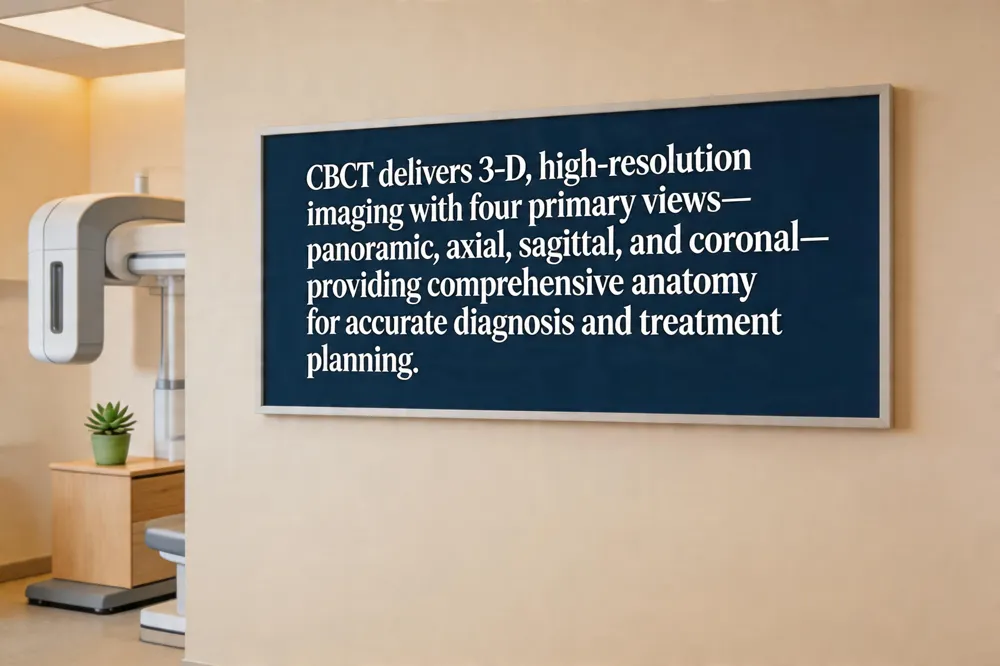
Cone‑beam computed tomography (CBCT) creates a three‑dimensional, high‑resolution image of teeth, bone and soft tissues, revealing bone defects, cysts and implant anatomy that a two‑dimensional panoramic radiograph (OPG) cannot show. An OPG offers a quick, low‑dose 2‑D overview for routine screening and alignment checks. CBCT’s spatial resolution—up to ten times higher—makes it ideal for complex cases such as implant planning, orthodontic assessment and maxillofacial surgery, while its radiation dose is modestly higher but increasingly reduced by low‑dose protocols.
CBCT vs OPG
Cone‑beam computed tomography (CBCT) creates a three‑dimensional, high‑resolution image of teeth, bone and soft tissues, revealing bone defects, cysts and implant anatomy that a two‑dimensional panoramic radiograph (OPG) cannot show. An OPG offers a quick, low‑dose 2‑D overview for routine screening and alignment checks. CBCT’s spatial resolution—up to ten times higher—makes it ideal for complex cases such as implant planning, orthodontic assessment and maxillofacial surgery, while its radiation dose is modestly higher but increasingly reduced by low‑dose protocols.
Four Primary CBCT Views 1. Panoramic reconstruction – a single wide‑field 2‑D image of the arches. 2. Axial (horizontal) slices – assess width of jaw, sinus anatomy and buccal‑lingual tooth position. 3. Sagittal (vertical side‑to‑side) slices – evaluate root height, canal proximity and lesion depth. 4. Coronal (frontal) slices – view vertical bone height, sinus relationship and symmetry.
Reviewing all three orthogonal planes (axial, sagittal, coronal) together with the panoramic view gives a comprehensive 3‑D picture for accurate diagnosis and precise treatment planning.
AI Segmentation and Diagnostic Software
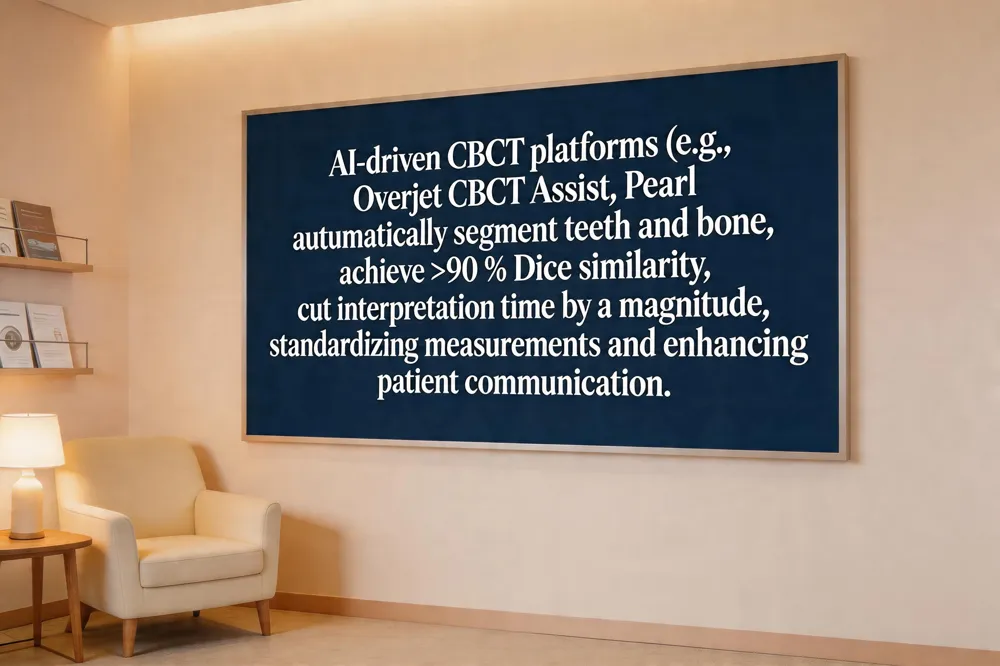 AI-driven cone‑beam CT (CBCT) analysis is reshaping dental diagnostics. A fully automatic AI system now delineates each tooth and the surrounding alveolar bone in seconds, achieving Dice similarity coefficients of 91.5 % for teeth and 93.0 % for bone—matching expert radiologists while cutting manual effort by 500‑fold. This speed enables rapid creation of accurate 3‑D models for orthodontics, implants, and restorative work. The AI software landscape includes FDA‑cleared platforms such as Overjet and Pearl. Overjet’s CBCT Assist (FDA‑cleared 2025) automatically labels, segments, and quantifies bone levels, airway dimensions, and nerve proximity, delivering real‑time measurements that standardize treatment planning and improve patient communication. Pearl AI offers comprehensive detection of caries, bone loss, and periapical lesions on both 2‑D and 3‑D images, providing automated segmentation and quantitative metrics that streamline workflow and enhance diagnostic confidence. Together, these tools reduce interpretation time, minimize inter‑observer variability, and support personalized, evidence‑based care at practices like Southern Boulevard Dental.
Education, Free Tools, and Preventive Principles
 CBCT interpretation course online – Accurate 3‑D imaging is essential for modern dental care. Reputable platforms such as BeamReaders now offer fully self‑paced, on‑demand series that cover CBCT fundamentals, anatomy, and systematic search patterns. Their three‑part course (5 CE credits, $600) and a supplemental 3‑CE implant dentistry module ($300) include downloadable DICOM cases and meet ADA CERP standards, helping clinicians at Southern Boulevard Dental stay current and improve patient outcomes.
AI dental X‑ray analysis free – Free AI tools are available for quick screening and patient education. Align’s X‑Ray Insights trial automatically annotates radiographs with color‑coded findings for caries, periapical lesions, and bone loss. Jenova’s Dental Image Specialist and the AI:Dental app also provide no‑cost analysis of panoramic, bite‑wing, and periapical images, offering a useful second‑opinion while more comprehensive paid solutions may be needed for full practice integration.
What is the 80/20 rule in dentistry? – This principle notes that roughly 80 % of oral disease originates from 20 % of teeth, typically the back molars with deep grooves. Emphasizing daily oral‑hygiene habits and regular check‑ups addresses the high‑risk teeth, allowing patients to allocate most of their effort to prevention and reserve professional treatment for the smaller subset of problems that do arise.
Regulation, Safety, and Patient Resources
 Artificial intelligence in CBCT
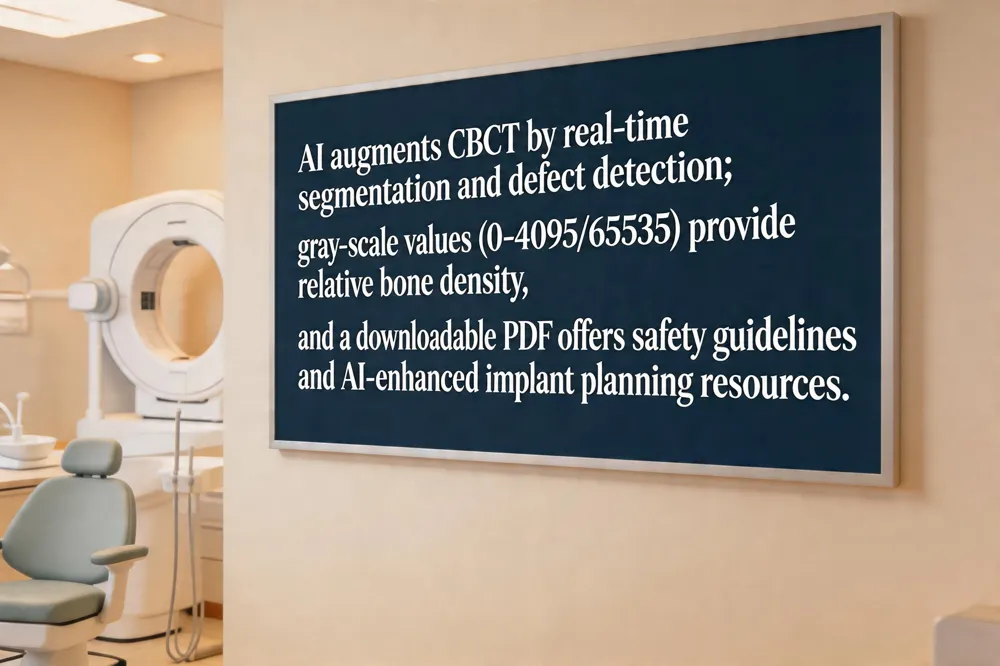
AI augments cone‑beam CT by automatically analysing the 3‑D volume, highlighting teeth, roots, bone density, lesions, and TMJ abnormalities. Real‑time segmentation and defect detection shorten interpretation time, standardise reports, and give patients visual overlays that clarify diagnoses and treatment options.
Artificial intelligence in CBCT
AI augments cone‑beam CT by automatically analysing the 3‑D volume, highlighting teeth, roots, bone density, lesions, and TMJ abnormalities. Real‑time segmentation and defect detection shorten interpretation time, standardise reports, and give patients visual overlays that clarify diagnoses and treatment options.
What is the GREY scale value in CBCT? The gray‑scale value (GSV) represents X‑ray attenuation for each voxel. Unlike Hounsfield Units in medical CT, CBCT GSVs are device‑dependent, ranging from 0 (air) to a scanner‑specific maximum (often 4095 or 65535). They are useful for relative bone density assessments within the same machine but cannot be compared across different units without calibration.
CBCT in dentistry PDF Our practice provides a free “CBCT in Dentistry” PDF that explains the technology, clinical benefits, safety guidelines, and how AI‑enhanced scans improve implant planning, surgical guides, and patient communication. Download it to learn more about the advantages of 3‑D imaging at Southern Boulevard Dental.
Comprehensive Reporting and Incidental Findings
 A Cone Beam Computed Tomography (CBCT) interpretation PDF is a structured, clinician‑friendly report that summarizes the three‑dimensional findings of a cone‑beam scan. It follows a systematic workflow: the volume is reoriented, optimal display settings are applied, and key sections (axial, coronal, sagittal, and cross‑sectional) are documented. Vital structures such as the inferior alveolar canal, bone volume and density for implant planning, and any pathological conditions are highlighted, often using standardized grading systems (e.g., Lekholm‑Zarb). The report also notes radiation dose considerations and any incidental findings, supporting clear communication among specialists.
CBCT offers high‑resolution 3‑D imaging of hard tissue, precise anatomy visualization, lower radiation than medical CT, and rapid, non‑invasive acquisition—benefits that improve diagnosis, treatment planning, and patient education. Limitations include limited soft‑tissue contrast, potential artifacts from metal or motion, equipment cost, and the need for training.
Common incidental findings on CBCT scans include soft‑tissue calcifications, intracranial calcifications, cervical vertebral anomalies, airway variations, and carotid artery calcifications, underscoring the importance of a thorough, standardized PDF report.
Cost, Insurance, and Patient‑Centered Care
 Patient communication is a priority: AI‑generated visual overlays on the CBCT images highlight teeth, bone density, and any pathology in an easy‑to‑understand, color‑coded format. These visualizations are shared during the consultation, allowing you to see exactly what the clinician sees, ask informed questions, and participate in shared decision‑making. By combining clear pricing, proactive insurance assistance, and AI‑driven visual explanations, we aim to make advanced imaging both affordable and patient‑focused.
Future Outlook
As AI algorithms continue to evolve, they will further refine 3‑D CBCT analysis—delivering even more precise segmentation of teeth, bone, nerves and pathology, and enabling predictive analytics that forecast implant success or disease progression. Ongoing model training with diverse, anonymized datasets will improve robustness across scanner types and patient demographics, while FDA‑cleared, HIPAA‑compliant cloud platforms ensure safety and privacy. At Southern Boulevard Dental, we remain committed to pairing these technological advances with our family‑oriented, patient‑first philosophy. AI will serve as a dependable second set of eyes, shortening interpretation time and reducing variability, but every diagnosis and treatment plan will still be reviewed and personalized by our experienced clinicians. This synergy of cutting‑edge AI and compassionate care ensures each patient receives accurate, timely, and comfortable dental treatment.